
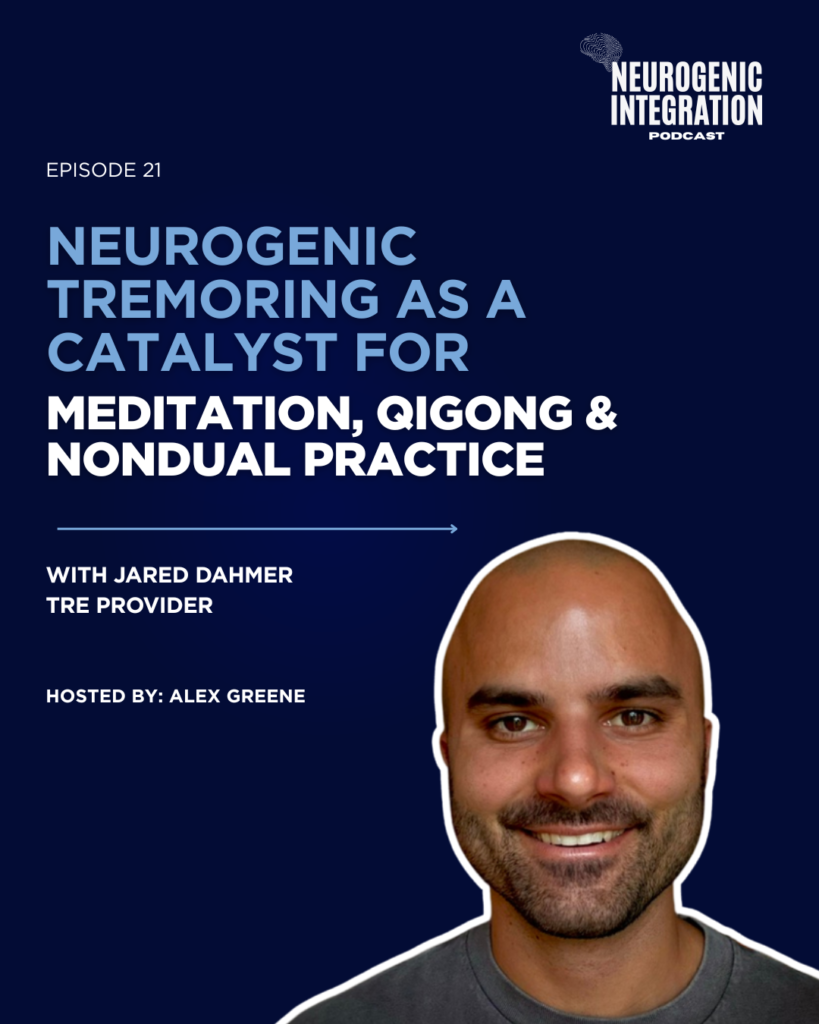
Most people arrive at Neurogenic Tremoring looking for relief — from stress, from tension, from the weight of something the body has been carrying. Jared Dahmer arrived looking for something else: depth.
By the time he found Tension and Trauma Releasing Exercises (TRE®), he had already spent the better part of a decade inside ancient yoga, Daoist Qigong, and nondual meditation. He had teachers, practices, and years of disciplined study behind him. What he didn’t expect was that a single video — found mid-session, on the floor of his own room — would become the thing that finally let all of it land in his body.
In a recent conversation on the Neurogenic Integration podcast, Jared sat down with Alex to trace that journey. What emerged is a story about an idea we find quietly radical: that tremoring isn’t only a way to discharge stress. For some people, it becomes a doorway into deeper presence, deeper meditation, and a more embodied life.
What is Neurogenic Tremoring?
Neurogenic Tremoring is the body’s natural, self-regulating tremor response — the same mechanism many mammals use to discharge stress after a threat has passed. Tension and Trauma Releasing Exercises (TRE®), developed by Dr. David Berceli, are a simple set of exercises that gently invite this tremor to begin, so the nervous system can release patterns of tension it has been holding.
It’s worth saying plainly: tremoring isn’t “shaking something out” in a dramatic sense, and it isn’t a cure. It’s a way of supporting what the body already knows how to do — returning toward a calmer, more regulated baseline.
From Qigong and Kriya to the body itself
For years, Jared’s path was rich but heady. He studied Qigong in a respected lineage, worked through an encyclopedic yoga and Kriya text, and explored nondual meditation. He describes years of accumulating “mental knowledge of spirituality” — real understanding, but understanding that hadn’t fully dropped into the body.
Then he tried TRE. “Everything became felt in my body,” he says of his first months of practice. The frameworks he had studied for a decade stopped being concepts and started being sensations. The fight-or-flight responses he felt he’d carried since childhood began to soften. Even his breath, he noticed, came back — fuller, easier, less guarded.
“I feel myself”: tremoring and presence
Ask the people Jared has taught what changed for them, and he says the same phrase comes back again and again: I feel myself.
Not a new self. Not a more impressive self. Just less of the character we tend to perform — the version of us that manages how we speak, how we sit, who we are in each room. As that armor softens, what’s left is presence. And from that place, Jared found that everything else got easier: his meditation, his Qigong, his breathwork. Not because he was trying harder, but because his nervous system finally felt safe enough to let go.
This is where emerging interest in the nervous system meets contemplative practice. So much of what makes meditation difficult isn’t a lack of discipline — it’s a body still braced for threat. When the body settles, attention has somewhere to rest.
Lowering your baseline
One of the most useful ideas from the episode is the notion of lowering your baseline.
In polyvagal terms, we often talk about returning to our ventral vagal baseline — a regulated, socially connected state — after stress moves us into sympathetic arousal or shutdown. But Jared and Alex explore a further question that Dr. Berceli has raised: what lives beneath that baseline? Can a consistent practice gradually deepen our resting state, so that genuine calm becomes more familiar and more available?
That’s the heart of long-term tremoring as Jared describes it. Practiced gently and consistently over months and years, TRE can keep releasing held tension — and as that load lightens, the body’s default settles lower. Life still brings jarring, intense moments. But the return to ease becomes quicker, because some part of you already knows the way back.
A note on pacing and safety
Jared is the first to wave a caution flag about his own early enthusiasm. In the beginning he practiced in very long sessions — far more than we would ever suggest — and he’s candid that more is not better. “Don’t do this at home,” he says of some of his early experiments.
This matters. TRE is not one-size-fits-all, and the nervous system responds best to a measured, well-supported approach. One of the most valuable shifts in Jared’s practice came when he learned to pause — to tremor for a short while, rest, let the body integrate, and only then continue. He compares it to resting between sets at the gym: the pause is where the benefit consolidates. Lying still afterward, he found, the body almost seems to meditate on its own.
Learning to tremor safely — with the right pacing, titration, and support — is exactly what trained guidance is for.
Tremoring as “medicine for the nervous system”
Perhaps the line that captures it best is Jared’s own: TRE is “almost like a medicine for the nervous system.” Not a pill that fixes us while we wait passively, but a support that meets our willingness to change and helps us move through the resistance that keeps us stuck.
And underneath all of it is something simple. Asked for closing words, Jared didn’t reach for technique. “I just want the world to feel safer,” he said, “inside and out.” Tremoring, for him, is one accessible way people can begin to feel safe enough to feel — and from there, to live with a little more authenticity and ease in their own bodies.
Curious to explore tremoring for yourself?
If this conversation sparks something, the best next step is to feel it in your own body — gently, and with guidance.
- Join our live weekly online classes to experience Neurogenic Tremoring in a supported setting.
- Drawn to share this work with others? Explore our Online TRE® Certification.
And to hear Jared’s full story — the discovery, the long-term practice, and where tremoring meets nondual meditation — listen to E21 of the Neurogenic Integration podcast.
Neurogenic Tremoring supports nervous system regulation and complements other wellness and meditative practices; it is not a substitute for medical or mental health care. Individual experiences vary.
E21 — Jared Dahmer · Corrected Transcript
Speakers: Alex (host, Neurogenic Integration) · Jared Dahmer (guest, TRE® provider)
Lightly cleaned for readability — filler words and false starts removed, meaning preserved. Names and terms corrected (Jared Dahmer, Michael Winn, Mantak Chia, Mika Devos, Tree Wiseblood, Christina Guillaume, Kriya, dharana, dhyana, kundalini, shakti). Timestamps are from the recording.
[0:00] Alex: All right, awesome. Welcome, everybody, to the Neurogenic Integration podcast. I’m sitting down today with Jared Dahmer, currently based in Louisiana, in the Deep South of the United States — though he’s sometimes all over the place; we’ll talk a little about that. Jared is a TRE provider. He went through the Red Beard TRE certification program somewhat recently, so I got to know him first as a student, and then we’ve stayed in touch as he’s been out running as a TRE provider.
What’s always intrigued me about Jared is that everybody who comes to neurogenic trembling comes from their own path, for their own reasons — and Jared came in with a really interesting background, doing a lot of Qigong and Daoist practices and meditation work. [1:00] Part of what we want to talk about today is how his neurogenic trembling practice has informed, related to, enhanced, and expanded his explorations in the meditation world — nondual meditation, Daoist practices, things like that.
What I laughed about when I first met you, Jared, was that — well, you’re not the only one; I had this phase in my early days of trembling too — but you did some serious deep dives, some very extended, long practices. And you also paid a lot of attention to how your nervous system was receiving that, what the effects were. So my hope today is just to have a wide-ranging conversation about your personal journey with trembling, [2:00] how it’s evolving as you’ve spent more time with it, and now that you’re sharing it with others. Jared, thanks so much for taking the time to sit down.
Jared: Thank you so much, Alex. I really appreciate the introduction. So, I’ve been doing Qigong since — let’s see, it’s 2026 now — I started in early 2020. It was a journey to get deeper. I was in a partnership with a woman, and I wanted a deeper connection with her — intimacy, heart connection, a connection in my spirit with the woman I was with. So I started learning that, and eventually I got into Qigong even deeper, because I was like, how much deeper can I go?
So I went to study with my teacher’s teacher. My teacher in the beginning was Jonathan White — [3:00] he has a YouTube channel called Sexual Kung Fu, a really beautiful channel. And his teacher is Michael Winn, who’s been teaching Qigong since the late ’70s, and who started with Mantak Chia. Mantak Chia is one of the original guys who kind of blasted Qigong into the Western world for all of us to understand. So it’s been really beautiful — I started this path with Qigong.
So I’m 34 right now. When I was 20, I had a really profound LSD trip. I wasn’t trying to have a very intense trip, but it was really intense. I was playing baseball with my buddies that summer, and I’d only tried cannabis before that. My friends were like, “Hey, let’s try this LSD thing.” I’d been listening to Alan Watts, all the things about Buddhism — so I was like, cool, let’s try it. [4:00] And what it did was just blast open my whole consciousness, blast open who I was. The whole eight hours of the trip, I was getting blasted by images, things from my past, memories, all kinds of stuff coming up to the surface. That was my first real introduction to spirituality.
It was a week after that trip that I went on YouTube — this was 2012 — and listened to a guided meditation, like a 10- or 15-minute one. And after I finished, life looked completely different. It was like I’d had an awakening. So my journey started in summer 2012, and it’s been a wild journey ever since. I started studying ancient yoga — I had this really thick book called Yoga and Kriya —
Alex: Hang on a second — let me pause you once in a while, just for definitions. [5:00] You know Qigong, and we’ll come back to it, but just for any listeners — I think a lot of people know “tai chi, qigong,” but just in case: what’s the translation of Qigong? What would be a one-sentence description? And you mentioned Mantak Chia — I totally agree he’s the person who really put this on the map in Western consciousness. Just give a short version of what that practice is about.
Jared: Sure. The basic definition: Qigong is the art of subtly moving your breath through your body — the skill of being able to move your breath. But how I describe it is, it’s a way to enhance your life force. It’s a way to feel super alive in your body, and connected to your spirit, which lives in your body. For me it’s not religious — [6:00] it’s non-denominational, and if you are religious, it can connect you to whatever you’re following. It’s a really beautiful practice that enhances your life force, which gives you physical health, emotional health, spiritual health. That’s my definition of Qigong.
Alex: Perfect, thank you. Okay, so now — you’ve got this big book, Yoga and Kriya. You’re going to have to tell us what Kriya is. I know what it is, but…
Jared: Sure. So it’s like a twelve-hundred-page book — it’s orange, Yoga and Kriya — and it essentially takes you through every aspect of yoga that’s existed since yoga existed. The yoga we see in studios today is a very small portion of the amount of yoga that actually exists. So you start with asanas, which is what you see in studios today, and then you go into pranayama, and then into dharana, which is focus, concentration —
Alex: Well, hang on — pranayama’s breath. So we have asana — [7:00] asana’s physical postures, pranayama’s breath…
Jared: Pranayama’s breath, and then dhyana. So you have dharana first — very focused concentration; you can use mala beads to go through different mantras, things you say to yourself to focus on each bead, to keep you in a very deep state of focus. And then you have dhyana, which essentially is meditation.
Alex: And by the way, just because I have a Zen Buddhist background — dhyana is, if I understand correctly, the Sanskrit that translates to “Zen.” Dhyana becomes Chan in Chinese, and then Zen in Japanese.
Jared: Beautiful. Yeah.
Alex: Cool. Okay, keep going.
Jared: So you have dhyana, and then, interlaced in this tradition, you have kriya. Not all yoga had kriya, but it’s a pretty significant part of it. [8:00] Kriya is essentially being able to open up your spine, your nervous system, to receive more powerful energy through your body, so you feel more alive. Many traditions would call this energy the kundalini; some would call it the shakti. All it is — this kundalini, this shakti — is a very powerful energy at the base of your spine that permeates through your whole body. You feel extremely alive, turned on by life from within.
I feel like we can jump into so many categories here, because this is such a hot topic — and TRE actually plays a significant part in all the stuff I’m talking about. But we’ll get to that.
Alex: We’ll get to that — we won’t forget.
Jared: So this is what I got into in my early 20s. I studied it for about six or seven years, going as deep as I could. [9:00] I didn’t have a teacher; I had a book, and that’s what I followed. I’m pretty good with books — I like to read and follow things — and it was amazing.
So let’s fast-forward. I was living in a city called Mount Shasta, California — a really beautiful place, amazing people with different ways of thinking. You have people who love spirituality, and people who love hiking, because the scenery is beautiful. I was there with a woman, living with her, and through this whole process I was going deeper into my yoga. And there was a set of circumstances where — you know how sometimes certain things just aren’t working for you? My yoga wasn’t giving me the connection to my life that I was really wanting.
Alex: So just to pause and define “deep” a little — [10:00] it sounds like you’re the kind of person who, when you find something, you’re a diligent practitioner. You’d gone a certain depth, and then you’re looking for more. When you say, “How much deeper can I go?” — how do you define that for yourself?
Jared: For me, depth would be: how much deeper can I go into my body? Because my spirit lives in my body, and the spirit is all around us. I’ve always had this feeling — there’s a profound teaching, “the kingdom of heaven, the kingdom of God, is within you.” So my body is my temple that I go into. [11:00] I release tensions, I release dramas, I connect to deep emotions, and it helps me open up to my spirit, my aliveness, my breath, my life force — my chi, prana, all these different names for energy. That’s what I mean. I wanted to go deeper into myself, and yoga wasn’t taking me there anymore.
At the same time, Qigong just popped up — I think it was an ad I saw. It’s really funny, because now Jonathan’s my friend. I took his course, and it was amazing. It taught me how to go deeper into the earth through my feet — grounding — these very esoteric practices that are very applicable to life, opening up my body in brand-new ways. So I take his course, and then I study with his teacher, Michael Winn, [12:00] who had studied with Mantak Chia — he actually helped write Mantak Chia’s first few books, because Mantak was having a hard time with English in the late ’70s, early ’80s. So I studied with Michael for many years, and I still do. And I started studying with Mika Devos, a German-Dutch teacher who lives in Vancouver, Canada — her Qigong is more feminine, but it applies to everybody. It’s really amazing.
So I was studying all these different things, and a few years later I came upon TRE. Here’s my TRE path — this is before I met you. A few years ago, I’d gone through a significant breakup, and it was pretty intense. And a few years before that, I’d been doing solo psychedelic sessions with myself — starting with small microdoses, nothing intense, [13:00] and gradually taking bigger doses, always keeping it very safe. I’d taken one full hit of LSD at that time. I laid down, had some music on, some incense — a very safe environment. I had affirmations on my wall: “You are safe. Just breathe. Get through this experience.” So I’d created parameters of safety in my room as I’m undergoing this ceremony with myself, because there’s nobody to really do these ceremonies with, especially in the world today.
Towards the end of this psychedelic session — I wouldn’t say it was a bad trip, but it was extremely uncomfortable. Emotionally, I’d just gone through that breakup; so many intense emotions coming up. I was using all my practices — the inner smile, smiling to my emotions, the six healing sounds, all these Qigong practices to start releasing emotions, [14:00] different breathwork to actually feel and help the emotion come out. But nothing was really grinding the gears. So I was like, what do I do?
I opened up Google on my phone — this is towards the end of the session — and I keyword-searched “how to release trauma.” And a video on TRE came up. It’s called Trauma Releasing Exercises — I’d never heard of it in my life. So I click on the video, and the lady is speaking a whole lot, so I have to get through a bunch of talking, and finally I get to the warm-ups. With full-blown TRE there are like seven warm-ups, but she gives me two. So I do those two — and mind you, I’m towards the end of an LSD session —
Alex: You’re still in the medicine a little bit.
Jared: Yes. [15:00] So I’m doing these warm-ups on the floor, doing wall-sits, following a video on my iPhone. And then she says, “Okay, lay on the floor.” We do the final warm-up, and then she starts to instruct closing the legs. So I start to close the legs, and I start getting these tremors, these shakes. At first — because I’m undergoing this medicine, I’m completely surrendered to the experience — my shaking is very intense. And it keeps happening, and I just start laughing, because it feels so good. It feels like I’m being tickled from within my body. I’m feeling new feelings, a brand-new connection to my body, and it’s like, this is intense. And after the laughter come very intense tears. [16:00] I start crying a whole bunch — “This is amazing” — these deep tears, crying and crying. And I’m doing this for like 30 minutes to an hour; the video’s long gone, because I’m just loving the experience. It feels so good — so deep, so juicy, so thick with peace and safety. And that’s what I’m getting at today: the experience of peace and safety is why I’m here.
What’s really amazing is I was able to go through this so-called bad trip, this extreme discomfort, and just transmute it into safety, into a feeling of tranquility in my body. It just blew my mind. So the following day, after my LSD session —
Alex: Wait, hang on — what year was this, approximately?
Jared: This was 2024 — summer 2024. So this was two years ago, almost two years ago. [17:00] The day after this experience, I open up Reddit. I’m trying to find everything I can about TRE, because I’m fascinated. I’ve done yoga, meditation, Qigong — and what TRE gave me was something I’d never found with all these experiences. Of course I’d found it a little bit, but there’s something very unique about TRE that, for me, nothing I’d ever done connected to. So the next day I look up TRE on Reddit, dive deep, read almost all the articles I can. And then I do TRE — because there’s a very active community on the long-term TRE subreddit. Their main thing is that if you do TRE for a year, multiple years, you can release all tension, all trauma from your body. And after you release all this, you can go deeper into your meditation, your spiritual practices, [18:00] and your practice will have like a 10x effect, because you’ve released so much tension. We’ll go into that later. But I did TRE again for another hour — and again, deep safety, deep peace. And I was hooked. After that I started practicing for many, many months. I even taught a huge group of people before I’d actually done the teacher training. I told my friends, my family, everybody, that they need to do TRE, because it was so amazing. So that’s kind of my journey, and where I’m at with this right now.
Alex: Incredible. That’s a beautiful capture. That’s cool, because I’ve heard some of this, but not all linked together like that. [19:00] Okay — I still have a bunch more questions. Can I keep firing questions at you?
Jared: Yes, go for it.
Alex: So you already had pretty deep experience with yoga, Qigong, breathwork — very embodied — and meditation as well, I assume. But something was different about TRE; it gave you this peace feeling immediately. Let’s focus on an arbitrary time period — maybe three or six months, your initial period of doing it a lot, daily or however often, before you joined the certification program, when it was purely a personal practice. Let’s say three months. What was that first three months like? What kept you going to it? What was changing?
Jared: That’s a really great question. [20:00] Those first three months of TRE, it was almost like I was going as deep as I could into my body. That may seem weird, but I’ll explain: I felt more in my body, more alive, more energy, and less anxiety. I felt a very strong sense of innate joy coming online. I’d been doing yoga, Qigong, meditation — so I had a framework of different spiritual and energy practices I’d been doing for the past decade. Once I landed into TRE, it just exploded. All the knowledge I’d had, this mental knowledge of spirituality — everything became felt in my body. So the first three months were such an opening, such a release of fight-or-flight responses I’d had stuck in my body since birth, such a release of survival patterns that didn’t feel good. [21:00] What I first noticed was a deepening of my breath. I told this to so many friends — one of them is a breathwork instructor, Calvin. I said, “Hey, what I’m noticing about TRE is that I’m getting my breath back.” And he’s like, “What are you talking about?” As I did more TRE, I could feel my body breathing, and it was like I was getting more energy, more life force — all that old breath that was stuck in shock, panic, trauma, was now coming back to me. I felt younger, rejuvenated. I had more passion, more drive, more energy. It started giving me an awakening. I felt more myself.
And I’ve taught TRE to so many people — I’ll digress a little — and the one thing people tell me the most is, “I feel more myself.” [22:00] Instead of playing a character in life — “I’ve got to talk this way, speak this way with this person” — when you start doing TRE, it allows you to let go of the character and just be. Presence. Being. Nowness. So my meditation — boom — everything unlocked, everything became easier. My Qigong, my breathwork, my meditation — it just opened. I could be present without trying. It was so beautiful. So my first three months were very beautiful. I felt like I’d had a rebirth, in a certain sense, which was remarkable.
Alex: Wow. Okay — but I remember one phase, when we were in certification, which takes close to a year from start to finish. [23:00] When we first got started, you were doing it quite a bit — often an hour or two, sometimes more, daily — with a lot of these benefits you’re naming. And obviously your system was — for some people that would be way too much, so, any listeners: TRE is not one-size-fits-all, everybody’s quite different. But for you personally, having that phase of quite long sessions, your body, mind, nervous system was basically saying yes to that. But I remember a phase of our learning when you told me, or the group — I can’t remember if it was in class — that you were trying something new: pausing more frequently, pausing for integration. That was a little newer, and there were some benefits you were getting from adjusting your practice that way. [24:00] Do you remember what I’m talking about, and could you speak to it?
Jared: So my question to you is: are you speaking about me pausing during my TRE session, or pausing between how many times I practice TRE per day, taking a break between?
Alex: Yeah — I can’t remember anymore. I thought it might’ve been about pausing inside your session, but it might’ve been about slowing down. But is that true — have you experimented with how much you’re doing, how much pausing, how much in between?
Jared: I have phases of both — inside the TRE session itself, when I’m on the floor, and phases of pausing how many times I actually do TRE — taking a week off, a month off. So let’s go inside the session. [25:00] When I pause inside my TRE session, it’s kind of like when I’m at the gym trying to get a pump — I’ve got some weights, trying to get ripped, lifting hard. If I lift for one hour straight, I’m going to have no energy; there’s no point. So you take a break between — do one set, take a break, another set, take a break. When I first started TRE, I was doing like a three-hour session — and this isn’t… please don’t do this at home. I’m like a guinea pig for a lot of things — psychedelics with TRE — don’t do this at home, because it can bring up a lot of things. Your body may say yes to it, but you have to find that out yourself. So anyway, I’d do three-hour sessions, two-hour sessions, and I’d just keep going and wouldn’t stop. [26:00] And eventually you came into the training, where it’s like, “Let’s do some TRE, and let’s take a break.” It was new to me. We were doing a training together, and you’re like, “Hey, let’s take a break between this session,” and I’m like, oh — this actually feels amazing. And then, when you instructed us to go back into the TRE, I was like, this feels more powerful. So I loved it. It’s been great. I’ll do TRE for like five or ten minutes, take a break, wait until my body is feeling so peaceful and safe, and then — boom — do it again.
In addition to what you taught me, I feel it’s equally important, after a session, to just lie down for the amount of time that you did TRE. [27:00] Say you do TRE for 20 minutes of shaking, then 20 minutes of lying down, of integration — you can even double it at the end.
Alex: Like a meditation, or some sort of…
Jared: Yes. And I almost find that TRE itself, after you finish and you lie down for 20 minutes — or double the time, so 40 minutes if you’ve done 20 — just lying down, it’s almost like your body knows how to meditate. It’s a really strange thing with TRE: the body knows. You don’t have to consciously do anything, you don’t have to try; it’s happening. And this is the medicine of TRE that I find so beautiful. When I started meditation, I was 20, and my body was full of tension. [28:00] So as I got into meditation, I was full of tension, and it was like I had to go through that tension to get to a meditative state. So when I teach people TRE, they’re shaking, shaking, shaking, and then I take them through a really short body scan — feeling all parts of the body — and they drop into a meditative state like it’s nobody’s problem. They’re like, “I can’t believe I got into this meditation state — sometimes it’s so difficult for me.” So what’s amazing about TRE is it’ll drop you into a meditative state — a deep state of relaxation where your body can digest, and you can go into a deeper state of meditation.
And that’s the medicine of TRE — this is what I’ve been wanting to talk about this whole time. With TRE, you start at a state of relaxation that you already have in your life. [29:00] That’s where you’re starting. As you do more and more TRE, your permanent state of relaxation starts to get deeper and deeper.
Alex: Okay, let me share something quick, because I don’t think we’ve had this conversation. You know the polyvagal curve — there’s the baseline, then sympathetic arousal, then freeze, immobilization at the top. We use that to understand the stress states of the nervous system. One of the goals of TRE is to bring us back to our baseline, our ventral vagal physiology. But there’s a concept — David lectures on this sometimes, maybe you’ve seen it on YouTube — where he started asking: what’s beneath the curve? You’ve got your baseline — but could you lower your baseline? [30:00] What happens when you not only restore neutral, but actually deepen that baseline? In my own experience too — before I came into the TRE world, like you, in my 20s I had a big interest in Zen meditation, Japanese martial arts connected to meditation — and for me also, TRE opened things up. It took what I’d already practiced and learned, and allowed it to sink in more fully into my body, mind, nervous system. And my view of meditative practices, Qigong, different traditions is that a lot of it is about exploring, learning, finding more depth within ourselves. [31:00] But I think you and I agree: the modern world is such that a lot of people are hanging out in unresolved stress. So almost step one is, can you get to a reasonably functional, calm state? And that’s not an ending point — the purpose of many practices is to potentially find increasingly deeper experiences of your body, your spirituality, whatever language we use. But anyway — I love your description of dropping into the baseline even further.
Jared: Thank you for going deep into that whole polyvagal description. For me, when I started my TRE journey — I’ve tried so many different things: ice baths, saunas, exercise, the gym, lifting weights, long runs, lots of yoga, meditation, Qigong. And sometimes morning sessions take two to three hours [32:00] to get into this really amazing, relaxed state — just feeling purely yourself, in the finest sense. Sometimes that’s really time-consuming. And there’s a huge biohacking culture — biohacking is a broad term, but it’s the culture of how to be your best self, how to improve yourself, how to evolve yourself. What I love about TRE is what we’re talking about: being able to deepen your parasympathetic state, deepen your permanent state of relaxation, get all the way down — and how much deeper can your state go, to where you’re embodying a profound state of relaxation? And even if you go into the world and experience fight-or-flight responses that are very intense and jarring, [33:00] your ability to get back into the state of relaxation is much easier. It’s a part of you that already knows it. So again, what I love about TRE is it allows me to get into this permanent state of relaxation, and get it deeper and deeper, to where I don’t need all these other biohacking things to feel good. Now I’m using those things to add to my life in a beautiful way, because I wake up full of energy, ready to go for a run immediately. Something about TRE has not only given me a lot of peace, it’s increased my life force tremendously. Now I can run five miles and it feels like I’m not even trying. I can go to the gym, work out, and it feels like I’m not even trying. [34:00] There’s something unique about TRE, especially for me, that’s given me such an increase in my aliveness, in who I am as a human being. It has so many applications — it’s unbelievable.
Alex: Amazing. It’s so inspiring hearing what you’ve discovered — what a testimony. So here’s my question. For you, as the “n of one,” it’s been a massive success. What I like about you so much is that you start here — “I want to take this all the way.” You’ve really pushed and explored very deeply with it and your other practices. And now — I’ve always said you’re going to be like the Pied Piper of… [35:00] well, luckily we have many; I think David is the OG Pied Piper of TRE. But what really propagates TRE in general is people who are enthusiastic — people like you who are just like, “Holy moly, I have to share this.” You’ve been doing that informally, and now you’re certified, formally, as a TRE provider. So now you have your own personal experience — the “n of one” — but you’ve also shared this with many other people. What are you learning from the people you’ve shared it with?
Jared: I’ve shared this with a wide spectrum of people. I think this is true with everything: if we want to change, then we’ll see changes happen in our life. [36:00] TRE is amazing in that it can start bringing changes in our life and our body — it can make things happen with ease and grace. I’ve talked to men and women. I’ve seen people have greater connections to their intimacy, their sexual energy — they feel like they can last longer in bed, more relaxed with their partner, their connection so much deeper, more present. Their communication in relationships is way better. So relationships can be significantly improved with TRE.
Also, the big thing about TRE is safety. Women start feeling more safe in their body, which is huge — when women feel safe, it’s incredible. I’ve taught this to women who’ve had chronic nightmares, women who don’t feel safe around men. [37:00] I had one friend who had chronic nightmares from a very traumatic incident — she was driving a car, and a person walked into the street while she was driving. The person was on some really hardcore drugs, and they passed away. For my friend it was an extreme trauma — hitting somebody who was drug-induced, who walked into the street, and then that person passes away. Huge trauma. She had nightmares for five years straight. She had to see a therapist once a week to get the stuff out of her mind, and use substances like alcohol to fall asleep. It’s not a great life. So when I taught her this practice of TRE, she was able to just release that. [38:00] She did it for a month or two straight — three times a week, fifteen minutes each — and all of her nightmares are gone.
Another woman I taught was feeling really unsafe around men. She felt like, “Why are men doing this to me? Why do they treat me this way? Why do I feel this way?” And I said, “Hey, why don’t you come over and I’ll show you some TRE.” So she came over, I showed her, and within a month or two she found the partner she’s been with for more than a year. They have such solid communication, a beautiful relationship — it’s pretty inspiring. I also taught her some Qigong — some really beautiful alchemical Qigong — so she had a profound change in her life.
TRE is really deep, and it’s also wide in the spectrum of what it can do for people. [39:00] One of my buddies is a men’s coach — teaches men how to feel connected to their body. I taught him some TRE, and for him the biggest thing was he felt so much more present with his partner — not only during sexual connection, but day-to-day. He feels like he has more energy, like he can come home from work, do TRE, and just relax into his sleep. So — sleep, relationships, career, being able to feel safe in the world, being able to feel relaxed in what you’re doing — these are huge.
I’ve taught many people TRE. I’ve seen people release traumas just on the first go, and I’ve seen people not shake at all — that’s only happened one time. But what I really feel is, the way to make TRE very powerful is if we’re open to change our life — [40:00] instead of looking at TRE like another pharmaceutical pill that we take, and it’s just going to do all the wonders for us. I strongly feel — especially with everything we’re doing: meditation, TRE, psychedelics — there’s a certain element of taking responsibility for one’s life. So I take responsibility for my change, my growth, my evolution. If those are in order, then TRE will absolutely do wonders for you. But the magic of TRE is that it can start to get through resistance to change. It’s almost like a medicine for the nervous system to help us get through things, and really start to evolve in beautiful ways. It’s amazing.
Alex: That’s a good description — I like that. “Medicine for the nervous system, medicine to help us get through things.” I love that. [41:00] Let me pause for a second to reflect. That’s all awesome. So — how are you teaching now? Are you doing a lot online, a lot in person, a lot of groups? What formats are you doing a lot of this with?
Jared: For the past year, I’ve had a pretty close group. I wanted to do one year of a close group of friends, and friends of friends — a really beautiful group of people that I’ve been teaching TRE and Qigong to for the past 12 months. It was three days a week — Fridays, Saturdays, Sundays — for an hour each day, for one year straight. Teaching them really deep Qigong — very spiritual types — and TRE, and seeing how this can create change in a person’s life. [42:00] The whole year’s been amazing. I’ve seen people have some really big awakenings — feelings of greater energy, better sleep, better connection to their spiritual world, or however people feel that connects them. So I’ve been teaching this small group, and I’ve been teaching everybody I meet TRE. Ever since getting my certification, I’ve just been teaching as many people as I can — anybody who’s open to learn. Right now I’m open to taking one-on-one sessions — I’ll give my Linktree later. And eventually I’d love to teach some war veterans — that’d be amazing, to see how much change can come about, helping them release some things in their body. So I’m open for opportunity.
Alex: Cool. So a month or two ago, you emailed me, and we’ve had a few conversations [43:00] around your interest in going further into — okay, TRE is great for trauma, great for stress, all good stuff. But also, for you personally, this is a major catalyst for meditative practices, Qigong, inner growth, spirituality. So I said, well, there are people, besides me, you should connect with. Like — I think of Christina Guillaume, in Montreal, a person with a deep Vipassana background who’s done some podcasts and has an interest in studying the relationship between TRE and meditation. And then another woman in Australia, Tree Wiseblood — similarly, one of her areas of focus is TRE and the spiritual or meditative experience. I’m curious if you’ve been able to talk with anybody else, besides your own practice — anybody you’ve networked with in the bigger TRE world?
Jared: Yes. I’d initially emailed you about this, [44:00] and you connected me to Tree, who I emailed. She gave me such a wonderful description of TRE and nondual meditation. So — I’ll take the esoterics out of this — nondual meditation is a way to feel oneness with all of life, to feel connected to everything. Really beautiful; that’s a very basic description. Tree gave me insights: as you start getting deeper into TRE, you’re going to get deeper and deeper into your body, deeper into awakening. You might have a head awakening, a heart awakening, a belly awakening — and each of these allows you to feel much more grounded and rooted in your body, which is amazing. Because — I just got this book, I want to share it — [45:00] it’s a really beautiful book, The Direct Means to Eternal Bliss. A super short book, and it has one meditation technique that just blows my mind. It’s a really old technique — not something new that’s going to “evolve meditation.” It’s just being able to become aware of your awareness, to be conscious of your consciousness, to see the seer — the one that sees the thoughts, the feelings, the emotions — turning it around and looking directly at that. This is a very deep nondual meditation. And one Indian sage, Ramana Maharshi, very famous for nondual meditation — one of his deepest inquiries was asking yourself, “Who am I?” [46:00] If my body doesn’t live forever, my mind doesn’t live forever, then who am I? Being able to become aware of your awareness and ask “Who am I?” leads to a very beautiful stillness meditation.
So the main question I had for Tree was: I’m reading all these nondual teachers from 100, 200 years ago, and they keep telling me to let go of my body — “let go of your body, don’t worry about your body.” But the deeper I get into TRE, the deeper I get into my body, and the deeper states of meditation I spontaneously get into. It was like a paradox for me. So she explained — for me, I don’t want to go run off into the Himalayan mountains. I want to live in the world, connect with people, share things that can benefit their lives. [47:00] And Tree shared: as you go deeper into TRE, deeper into these nondual meditations, you’re able to have awakenings in your body that give you more energy in certain centers, that you can share with the world. As you deepen into your body, you deepen your desire to help others. That was really beautiful for me, because I’d had that intuitively. It’s good to see certain paths starting to blend — these really deep meditation paths, which tell you to run away into the mountains, starting to blend with the body as well. Because I’m on this earth; I want to live in my body. I’m not wanting to leave my body — I want to get into my body. The kingdom of heaven is within you; it’s within the body. So how much deeper can I go into the body with yoga, Qigong, meditation, TRE — [48:00] psychedelics, that’s optional — how can we go into the body and start to have insights we can share with others, to make the world a better place? That’s the journey I’m on.
Alex: Amazing. So cool. I’m really glad you connected with Tree — she’s wonderful. She led a workshop for Neurogenic Integration around wintertime, late last year, which was lovely. And I interviewed her once — a lovely conversation. Of course, in two hours it’s very introductory, but she did a beautiful job describing how this has been meaningful for her, and sharing some of her practices. It was really great to see that from her.
Okay — next up, right now, I’m going to make a pitch to you. [49:00] I want you to share a two-hour workshop with the Neurogenic Integration community — that format where, one or two times a month, we do these special guest workshops. The intention is for people to share what brings TRE alive for them personally. For some people that involves dance, for some it involves heart, whatever the case may be. As I listen to you today, I’d really love to see how Jared would lead a two-hour journey about what you’ve learned and how you’re sharing it with others. So — what do you think? Is it a yes?
Jared: I’m totally open. For sure.
Alex: Good. We’ll get that on the calendar. Awesome. So check in for a moment — see if there’s anything we haven’t touched on, anything you’d want to share, or maybe — [50:00] for people who are a little newer to TRE — what you think people should know, or be open to. Any closing comments that feel good for you.
Jared: You know, Alex, I’ve tried a lot of things, and I just want the world to feel safer — inside and out. Because we live in a world where people don’t feel safe. I’m saying this in context, because there’s a lot of anxiety, a lot of depression, a lot of emotional pain in the world that just keeps going, generation after generation. And also, people feel overwhelmed with the amount of information out there — sometimes people see so much information, they’re like, “I don’t even know where to begin.” So people get overwhelmed. I really feel that TRE has an amazing ability to help that overwhelm become more relaxed, more peaceful — [51:00] to take that overwhelm and allow people to get into a state where they can think more freely, feel more freely. They feel safe to feel things they haven’t felt in a long time. And TRE is amazing in that it helps people open up emotionally to things in their body that they really need to feel, really need to process. Once processed, they have more energy to explore other options, more clarity to see what is for them.
TRE is amazing for people who are religious and non-religious. It’s amazing for all spiritual types, in that it brings you closer to your core self — closer to the feeling of relaxation that all of us are looking for in whatever we’re doing. So I really feel TRE can be beneficial for almost everybody on the planet, [52:00] to start to relax into themselves, feel more themselves, and be better lovers, husbands, wives, mothers, daughters, sisters — everything. To live with authenticity, and with a feeling of, “I feel good in my body.” Because that’s what we want, big time.
Alex: Awesome. Well, Jared, I really like the way you describe these things. You have a gift for conveying the magic of things. Everybody’s going to put it into different words, but I really resonate with the way you describe them. To me, it felt really important to capture this conversation. So — big gratitude to you. We’ll put all your links and contact information in the show notes. [53:00] People listening: Jared’s a cool guy to connect with — do that. And he said yes to guest-teaching for Neurogenic Integration soon, so we’ll bring him in for a workshop as soon as we can schedule it. Super awesome. Really appreciated you taking the time for this conversation.
Jared: Awesome. Thank you, Alex. Appreciate you, man.
Alex: Yep. Thanks, Jared. Thank you so much.