
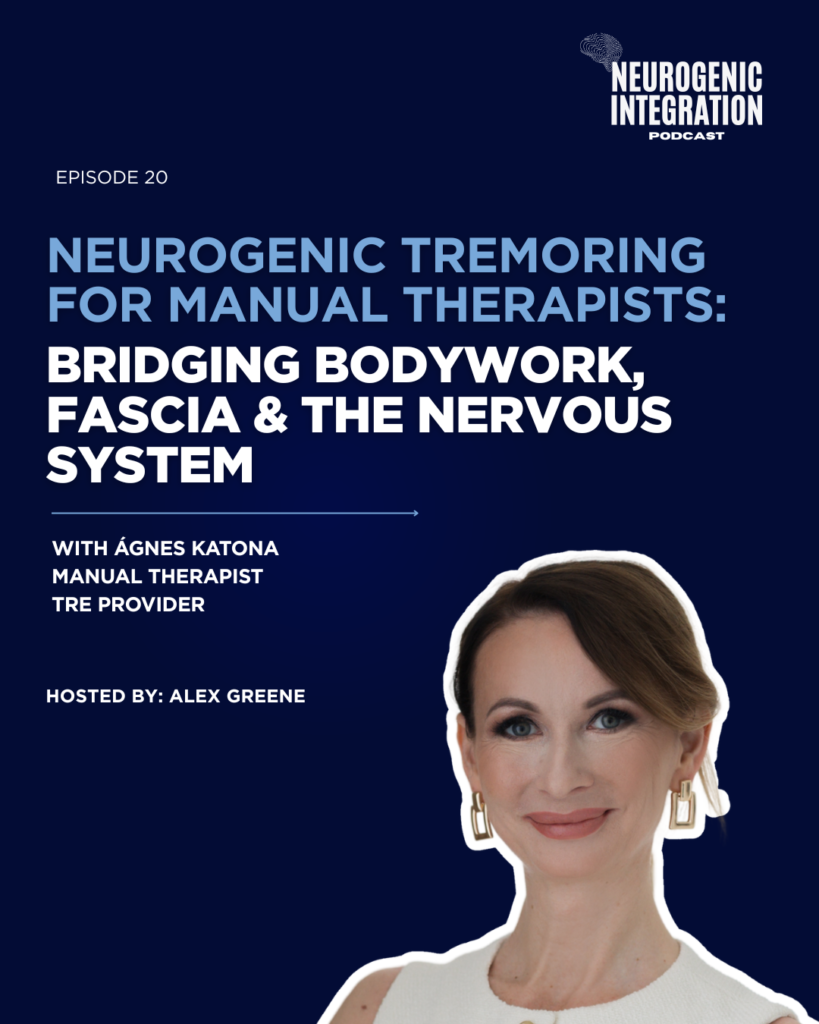
Most manual therapists can tell you, in fine detail, what’s happening in a body. They know the joints, the ligaments, the layers of fascia, the way one restriction pulls on another three regions away. They’ve spent years training their hands to read tissue. And yet so many of them reach the same quiet moment in their careers: a client they can’t quite reach. The assessment is right, the technique is right, the work is good — and still, something won’t move.
That moment is where this episode lives. We sat down with Ágnes Katona — a physiotherapist and manual therapist in Budapest — to compare notes on a journey it turns out a lot of bodyworkers are making without realizing others are making it too: the journey from working only with tissue to recognizing the nervous system as the piece that was missing all along.
What’s striking is how Ágnes and Alex arrived there the same way. Not through a textbook. Through their own bodies, shaking on a table, before either of them had language for what was happening.
“There’s nothing wrong with my body”
For years, Ágnes carried a quiet assumption that many people share: that shaking is a malfunction. Something to be embarrassed about. A sign the body has slipped out of your control. She was a trained physiotherapist who understood anatomy thoroughly — and even she had filed her own trembling under something is wrong with me.
Then she experienced Neurogenic Tremoring intentionally for the first time, and the story rewrote itself in a single session. The shaking wasn’t a symptom. It was the body doing exactly what it’s built to do — discharging held stress and finding its way back toward balance. “I always felt like shaking was something I should be ashamed of,” she told us. What changed wasn’t her body. It was her understanding of it.
This is one of the most common turning points we see. The tremor was never the problem. The belief that it was a problem is what kept people from letting it happen.
The body keeps its own record
Ágnes had done years of conscious inner work before she ever found tremoring — courses, methods, plenty of reflection on her own history. She genuinely thought she’d worked through it. Then, practicing at home one day, a wave moved through her body and brought a recognition with it: she’d been holding far more than she knew, and her body had been keeping that record the whole time.
There’s a lesson in that for everyone who works with people. You can reframe a story in your mind and still carry it in your tissue. The mind has its way of integrating an experience; the body needs its own. This is exactly the territory Bessel van der Kolk mapped in The Body Keeps the Score, and it’s why a purely top-down approach so often leaves something unfinished. Talking about it and moving it through the body are not the same event.
Cold bodies and warm bodies
One of Alex’s most useful field observations after years of pairing structural integration with tremoring is almost embarrassingly simple. Some people arrive in what he calls a “cold body” — not yet very connected to sensation, not very awake inside. Others arrive in a “warm body” — sensitized, aware, already listening inward, often through yoga, breath, dance, or a lot of prior bodywork.
The warm bodies make faster progress. Tissue releases more readily. Guarding lets go more easily. And here’s the practical upshot for any hands-on practitioner: tremoring is one of the most reliable ways to warm a body up. Clients who tremored a few times a week, on their own or in a class, consistently got more out of the manual work that followed. The tremoring didn’t replace the bodywork — it prepared the nervous system to receive it.
Two clients, two lessons
The case studies in this episode show what becomes possible when manual therapy and tremoring meet.
The first was a postpartum client whose body had been told, quite literally, that shaking was wrong — sedated after a cesarean to stop the very tremoring her system was trying to complete. On the table, the smallest vibration began to surface. Instead of shutting it down, we made room for it. Over a few gentle sessions her sleep returned, her anxiety eased, her shoulders softened — and then the structural work she’d originally come for finally had somewhere to land.
The second was a former kickboxer whose system was so protected it couldn’t receive touch at all. Manual therapy simply bounced off a body braced for impact. So we didn’t start with touch. We started with tremoring — and after one session she went back to the gym for the first time in months. Sometimes the most direct route to the tissue runs straight through the nervous system.
Why fascia made this a science conversation, not just a felt one
For a long time, bodyworkers could feel that stress lived in the body without being able to explain the mechanism. That’s changing fast, and the 2024 Fascia Research Congress was a milestone: Robert Schleip and Stephen Porges took the keynote stage together — the fascia world and the nervous system world, finally in the same room.
A few threads from that emerging research stayed with us. Fascia contains its own contractile cells — myofibroblasts — that can tighten and release. Unlike muscle, which answers to the motor cortex, fascia responds to the state of your autonomic nervous system. Roughly forty percent of the nerves in the thoracolumbar fascia of the lower back are tied to the sympathetic system — which is part of why stress so often shows up there. In one tracking study, a stressor produced increased fascial tension not immediately but about forty-eight hours later, easing back over the following days as the system settled. And people experiencing clinical depression showed measurably thicker fascia on average — a quiet echo of how we describe these states all the time: heavy, sluggish, stuck, versus light and free.
None of this is the final word, and we hold it as emerging research rather than settled fact. But the direction is unmistakable: fascia and the autonomic nervous system are far more entangled than most of us were taught.
Stress is not someone else’s job
Which brings us to the line from Ágnes that may be the heart of the whole conversation. Manual therapists often assume the nervous system belongs to someone else — a therapist, a psychiatrist, a different room entirely. But stress isn’t rare, and it doesn’t wait to be referred. It’s in the room with you, in nearly every client, whether you name it or not. “We have a beautiful profession — we work with the body,” she said. “And stress affects the body.”
You don’t need to become a psychotherapist to work with this. You need a way to support the nervous system, safely and within your scope, right there on the table. That’s the bridge this episode is about.
Listen to the full conversation
There’s far more in the episode than we can fit here — Ágnes’s path from physiotherapy into manual therapy, Alex’s first spontaneous tremor on a Rolfing table years before he had a name for it, and what it actually looks like to weave touch and tremoring together in a real treatment room.
Listen to E20 — Neurogenic Tremoring for Manual Therapists: Bridging Bodywork, Fascia & the Nervous System with Alex Greene & Ágnes Katona wherever you get your podcasts, and if it speaks to you, subscribe and leave a review — it genuinely helps more practitioners find this work.
You can find Ágnes at balancedyou.hu, and explore more of what we do — including our live weekly classes — at neurogenic-integration.com.
Warmly,
Alex & Siv
Neurogenic Integration Podcast — Episode Transcript
Guest: Ágnes Katona (Budapest, Hungary)
Host: Alex Greene (Boulder, Colorado)
Intro
Welcome to the Neurogenic Integration podcast, where we explore the incredible potential of neurogenic trembling beyond the basics. I’m Alex Greene, and I’m Siv Jøssang Shields. Together, we’ll be diving into how this natural, innate process can be seen and applied across different professions, healing modalities, and in scientific research. Whether you’re a practitioner, a coach, a therapist, a bodyworker, or a researcher, this podcast is for you. Join us as we uncover the science, share experiences, and explore how Neurogenic Integration is revolutionizing the way we approach stress, trauma, and well-being. So take a breath, get comfortable, and let’s dive in.
Conversation
Alex: Hi, everybody. Welcome to the Neurogenic Integration podcast. I’m Alex Greene, based in Boulder, Colorado, and I’m sitting here today with Ágnes Katona in Budapest, Hungary. She’s our guest, and somebody who I’m working on a major project with. So I’m excited to sit down and have a conversation with Ágnes.
Ágnes is the owner of a business called Balanced You Therapy and Learning Hub in Budapest. She’s a physiotherapist, a manual therapist, and a certified TRE provider — TRE being the neurogenic trembling that we talk about so much on this podcast. She’s been integrating trembling into her physical therapy and manual therapy worlds, which is a big interest of mine too. So that’s part of what we’re going to be discussing. Welcome to the show, Ágnes.
Ágnes: Thank you, Alex. Thank you for having me.
Alex: Very good. So what we’re working on is that later this year, in September, Ágnes is hosting me to present a four-day seminar for bodyworkers and manual therapists about trembling. In fact, the title of our seminar is “Neurogenic Trembling for Manual Therapists and Bodyworkers.”
What this program is, is a way of bringing the information about neurogenic trembling that many of us know from TRE — or related approaches — and taking that neurogenic trembling into the hands of touch-based therapists. So our audience in September will be physiotherapists, manual therapists, massage therapists — anybody who’s a touch-based practitioner is who’s going to be in our room together.
What I thought would be really fun to do in a podcast conversation like we’re going to have here today is for Ágnes and I to just kind of compare notes a little bit about our journeys and our stories, because both of us began as touch-based manual therapy practitioners who then learned about neurogenic trembling, and then came to the conclusion that it’s a very important awareness and skill set for bodywork therapists to have as part of their toolkit.
So that’s what we want to do — just sort of share our stories. And then we’ll share a little bit about some of the ways in which the fields of physical medicine, like manual therapies, and nervous system approaches are starting to come together increasingly. So we’ll talk a little bit about the fascia research and the Fascia Congress that happened last year, where Stephen Porges from the nervous system world and Robert Schleip from the fascia and connective tissue world came together in a presentation, talking about the integration of those things. That’s some information we’re going to be sharing in our seminar in September.
So we thought it would be fun to do a little bit of conversation about that here today. That’s kind of a preview of what’s on the menu for today’s conversation. Do we have time for all of that, Ágnes? What do you think — do we?
Ágnes: Absolutely. I’m just pretty excited to get deeper into this topic.
Alex: Very cool. Well, let’s share our stories, and let’s start with you. What I’d like to hear from you is a little bit about your own professional journey — what even drew you into physical therapy and manual therapy — a little bit about that professional journey, and then how neurogenic trembling got on your radar. Maybe somebody told you about it, or was it something you saw in your patients? So yeah, let’s just start with your story.
Ágnes: Yeah, sure. So I’m basically a physical therapist — this is how I started my journey, since I’ve always wanted to do some sort of a nice job. I was very interested in biology and the human body as a child, so I was really searching for something that is a nice profession to work with the human body.
I first started working as a physiotherapist, and I met a lot of clients with very complex issues and complex symptoms. Physiotherapy is very helpful, but I kind of felt like there was a missing link — something that was missing from my therapeutic tools. So as a physiotherapist, I was looking for something more holistic, something which has a more holistic approach. In Hungary, when you have a degree in physiotherapy, you can become a manual therapist, and I thought that this was a nice way to expand my knowledge and expand my holistic view — to get something which is a deeper tool, a deeper assessment, and just a deeper way of approaching my clients and the human body. And it helped me a lot.
Eventually, I learned a lot about how I could use my previous knowledge that I gained as a physiotherapist in my practice, and it was really helpful — until a point. Because I’m a curious person, and I’m always looking and searching for something additional that I can add to my job.
When I started using the manual therapy tools, I felt like I was good at my job, and I always got the feedback that I could help in very difficult and complex cases. The patients were really grateful for the work that I did — until the point I met some clients who were even more complex than I’d met before. “Complex” means they didn’t just have a simple symptom; they also had a systemic problem. In the therapy, we were working together with manual therapy techniques and with some exercises, but after a certain number of sessions, we kind of hit a certain point where we couldn’t go further with the therapy.
However, I was able to help those clients a lot, but I kind of felt like, okay, there’s still something missing. When I was a child and I had to pick what I wanted to do as an adult — what profession I would like to choose for the rest of my life — I was, as I said, very interested in the human body. But I was also interested in what is under the skin: what happens inside, how our emotions and our thoughts actually work, and how they are interconnected. I never really gave up my interest in looking for something beyond the human body. And these clients kind of showed me that it could be really important, when we work, to have additional knowledge — not just about human anatomy, not just about the joints and ligaments and the tissues and the fascia, but also about how our body is connected to what actually happens to us: how my life, how the environment, how the stress, the trauma that I might experience, has an effect on the human body.
This is what I eventually discovered as a manual therapist — that for many clients it is really helpful to work with the body, but in some cases, in some more complex cases, the body involves more from our story. We meet a client on the treatment table not just by their symptoms, but with their whole story, with their whole life, and that has a huge effect on the body itself.
So pretty much, this is how, as a manual therapist, I was looking for some additional techniques — something extra that I could integrate into the work that I do. I knew that it should be something which has a connection with the human body, but which goes beyond the human anatomy that I already studied.
At one time, I had a client — a very nice client — and she came to my practice. She was having some jaw issues and some other issues with her body, and she was telling me about it. She said, “Oh, Ágnes, have you heard about this? There’s this technique, it’s called TRE. I’ve just heard about it, and it works with the body, and it works with some sort of shaking.” I got really curious, like, okay, wow, I haven’t heard about that. “How — what did you hear about it? Where can I gain more information about it?” And she sent me a website.
Then I started looking at, like, what is TRE? And I booked an appointment with a TRE provider, because I got so excited about the technique that I really wanted to have a personal experience — how does that look, how does that feel in the body? I got really amazed after my personal session, because the trembling that I experienced was, on one hand, very amazing for me. Like, wow, okay, this is a technique that can actually be used for helping clients and used as a personal tool to work with my body and work with stress experiences and trauma experiences.
On the other hand, it amazed me because, even though it was something new that I tried, it was also something very similar. Because I just remembered, at that session, that I think I’d already experienced this kind of shaking and vibration earlier in my life. It was very reassuring, just understanding that I’d experienced something very natural earlier — something which is part of my body, part of my human anatomy, part of my nervous system.
I felt amazing, because earlier I’d thought there was something wrong with my body. I always felt like shaking was something I should be ashamed of — that maybe something was not working well in my body, maybe there was something wrong with my body or something wrong with me. At the end of that session, I understood that, okay, there’s nothing wrong with my body, there’s nothing wrong with me. This is a completely natural working of my body — a completely natural way of my body expressing something, which eventually helps me to get more balanced.
I was so amazed after that session that I made the decision, at that moment, that this is the missing link. This is something that I would like to learn. So the first time we had the first TRE training in Hungary, I applied for that course, and I was really excited to become a TRE provider so that I could use this tool in my practice to help my clients with more complex issues.
Alex: Wow, very cool. Amazing sort of journey leading up to it. But I’m curious a little bit about your personal experience. I appreciated how you shared that when you trembled, you thought back, or you remembered back, to some experiences when you had trembled as a younger person, earlier in life. And it helped you understand that that was natural — that it had been healthy, that it wasn’t a bad sign, that it was actually a good feature of your biology and all of that.
But in your first — let’s say first few months — you had that one session and you loved it, and then you joined the training. What do you think your personal benefits from TRE were in those early days? What were the biggest effects for you personally?
Ágnes: I think more than one thing. First of all, I really liked that I had a tool that I could use on my own. I always prefer, even as a therapist, gaining tools that can be offered to clients for personal use. So I really liked — and I thought it was amazing — that it is so simple to use. I don’t need any kind of equipment; I just need my body if I want to practice. So I thought, maybe this is not too romantic, but this is a practical tool, and it’s so easy to use. That was one very personal experience.
In the very first few moments when I started using it: I’m not too flexible — or I thought I wasn’t very flexible. As a physical therapist, I could see my body changing. I could see how those tissues could get more flexible, how I could actually find more flexibility in my body, how I could do movements that I couldn’t do earlier, and how I had an overall feeling that my body was lighter. It was a really nice experience about my body.
Another thing — and it was a kind of shocking experience, but also beneficial — was this. Before TRE, during my training as a physiotherapist and manual therapist, I attended quite a lot of courses just to work on myself. I always thought that someone who is a professional, who is in the field of helping other people, needs to work on themselves, to work on their history, work on their traumas. So I visited quite a lot of courses, I tried many techniques which aimed to work with the stress and traumas that I’d had earlier in my childhood. And I really thought — I was very sure — that, okay, I think I’d done quite a nice job. I think I’d worked pretty well on my history.
I remember one time I was practicing TRE at home, and that moment hit me so hard — I can remember it clearly even today. It was a very deep felt sense in my body, and also a recognition that, oh my God, I was affected by so many difficult stories in my life, and eventually my body still remembers it. I never thought about how affected I was in my body.
I can remember clearly — it was like when you look at the sky and there are clouds, and those clouds just go by, and then the sun comes out and you get a very clear idea about what’s happening. I remember that I got that clear idea: okay, this is amazing — how my body was participating in all these stories, and the challenges that I still might have are because I never really paid attention to my body.
I understood, at that moment, that everything which is part of our story is part of our body. Even when we are trying to live a conscious life, when we are trying to be very conscious about how we integrate our history, we always pay attention to what’s happening in the mind, how we reframe our story — but we never really pay attention to our body. That was a really personal experience: the moment when I felt in my body the importance of working with the body, even when we are conscious, even when we have a history of therapy, even when we have a history of working with our family history and traumas. So that was a really great moment that I still remember very clearly.
Alex: Well, that’s great. I love that. So let me share — I’m going to answer the same question about how I came to it and how I found it — but then I have a curiosity for you.
So let me share a little bit of my own story. I’ve told this in a few places, so I’ll try to give a short version here. For me, my original bodywork training was through the structural integration tradition — kind of the Ida Rolf, Rolfing style approach to myofascial work. Before I was even trained in that, my first tremor experience happened organically when I was in my early twenties. I had a hip issue, and somebody took me through the ten-session series of structural integration. I’d never had any sort of bodywork or anything like this before. For me, this was kind of my big — I guess I would call it a somatic opening — because it’s when I first discovered a little bit, like you’re sharing, that when you work with the body so much, there’s not only the physical issue. In my case, there was a kind of imbalance in my pelvis and my hips, but then it turned out it was connected to the history of my body and my nervous system and everything that went with it.
What happened for me was, when I was receiving this work and laying on the table — laying in a position that we actually use in tremoring and TRE, where the knees are up and the feet are flat — that’s how I was lying on the bodywork table. My bodywork therapist was working on my ribs, so I was breathing, and my legs were up, and then my legs, on their own, started to do this. I kind of looked at her, like, “Is this normal? Is this okay?” And she said, “That’s okay, this is just some sort of release. Go ahead and let it happen.” She just kept doing her work. So I relaxed more, and then I started to get more of this movement, and it kind of grew from there.
I ended up having — and I definitely didn’t know anything about TRE, or anything about the nervous system; I hadn’t studied human anatomy, so this was all totally new — I had this very big experience. It was probably ten to fifteen minutes, I don’t remember exactly, where my body and my spine really had this big release, and I felt very different afterward emotionally. I felt lighter, as you shared. But I was so surprised by this — it came out of nowhere — yet it somehow felt very important. So it really made a strong impression in my consciousness and brain, because it was so unexpected, but it was so powerful in a way.
So later on, maybe seven years after that, is when I became more and more interested in body-oriented work. I trained and became a structural integration bodywork practitioner. What was interesting is that I had remembered that experience. As I started to work with people in the style of work that we do — if somebody’s on their back, their legs aren’t just lying long, we always have their knees up; it’s just part of the approach of this particular style — because of that, not every client, but sometimes I would see a little bit of a tremor, or sometimes a bigger, more significant tremor like had happened for me. So this became a somewhat regular occurrence.
But I still didn’t know very much about it. It wasn’t part of the training. All we said was — in a way, at most, my teachers would say, “Oh, okay, that’s a release,” but it wasn’t much more than that. So I was very lucky. Like you, somebody — one of my clients — said, “Hey, have you heard of this work, TRE?” And I said, “No, I haven’t heard of it.” But then she ended up training in it and becoming certified, and I offered to be her practice person for one of her tests or something like that. So that was how somebody first guided me through the TRE process. When they did, I was so excited, because it completely duplicated the same thing that had happened seven or eight years before — and created the same thing I would see sometimes in my clients. I was like, “Oh good, somebody else knows about this.” But not only do they know about it, they know how to reliably make it happen. Somebody has also studied the neurobiology: why does this happen, and how to do it — not just have it happen when the stars align in the right way, but to have it happen on purpose.
So this was kind of my first opening. And then Dr. Berceli was coming to where I lived — this was near Chicago, in the United States — and so, very soon, several months later, I was already doing the certification program.
In my early days — and this is what I want to hear from you in a moment — because I was already a bodyworker, and then I learned trembling and thought, “Wow, this is amazing,” I started to introduce it to most, if not all, of my clients. I experimented in lots and lots of different ways. With some clients, I would teach it to them separately; I would ask them to do it independently, or I would have classes. In that situation, I made the observation that even if somebody never did trembling when we were doing our bodywork, I still found that the bodywork I was doing was happening much more successfully.
I was mostly doing the ten-session-series bodywork, or John F. Barnes-style myofascial release work. People who were trembling on their own, or in a class, were much more likely to have their muscles release. I would always say that it was like it warmed up their nervous system, or warmed up their body. So, instead of working on — I don’t know, I sometimes have very simple ways to explain things — I used to say there are people with sort of cold bodies and people with warm bodies. What I meant by that was: a cold body, to me, was somebody who wasn’t very sensitive yet — maybe they had never done much yoga or breathwork, so they weren’t very connected to their body yet. I knew from bodywork that we could wake them up in their body, and this would take some time — that’s a cold body. But a warm body is somebody who has, in a sense, woken up their sensation — maybe through yoga, dance, lots of bodywork — somehow they have more body awareness.
For people who have more body awareness, in my experience, the benefits of structural integration, myofascial release, visceral manipulation — all the bodywork tools I had — they would happen much better as somebody became more awake inside their body. So with some of my clients, the ones who were trembling one, two, three times a week on their own or in a group, they were making progress way faster. Their muscles were relaxing; if there was any guarding or emotional holding, they were much more likely to be able to release that — maybe have some tears or some anger or something coming in.
So that was one thing. But then I thought, well, okay, what if, not only if they do trembling a little bit independently — what if, while we’re working, I show them, not the seven exercises of TRE, but in a simple way, right here in our treatment room, how to wake up the tremor? Would that be a good format? Could I use that inside my bodywork sessions with much benefit? And I found out that this was very, very useful to do. Sometimes trembling was a large part of a sixty-, ninety-, or 120-minute session — sometimes a major piece, sometimes a few minutes, sometimes it was the integration of things. So I really started to explore the different ways that a bodywork therapist could work with trembling, in the treatment room and outside of the treatment room, to support the overall goals.
And just like — I love what you said earlier about looking for something that was a bridge into something holistic, not just about the fascia, the muscles, and those systems, but something that might connect us into more of the mind-body connection, or the emotional system, or the nervous system. That’s what I found — that I suddenly went from being a somewhat mechanically oriented person to: yes, there was still the mechanical treatment, but it now fit into this larger container that was much richer, had more benefits, things happened more quickly, and people had a tool they could do forever to regulate their nervous system. So this was kind of how this really developed for me personally.
So that’s what I’d love to hear a little bit about from you. After you got certified and had your personal experiences, you’re starting to introduce it to your clients — physiotherapy and manual therapy clients. I would love to hear what you discovered. How did you work with trembling? What were the benefits of it? Did people like it? Did they think it was weird? Please, share anything you can about that part of the journey.
Ágnes: Yeah, okay. I just loved this whole story you just explained, and how you discovered the TRE process. Some of it is very similar to what I experienced in my practice, and some of it is not.
When I became a TRE provider, I started to integrate TRE and tremoring into my practice — as you said, first separately, like a separate individual session, because this is how I was taught to do it: just the exercises. This is how we help clients to start trembling at the beginning. I thought it was really useful. I had the same patients coming, so it was an additional tool that I could offer. Like, okay, we now have this on the plate; if you feel like it, you can give it a try, and I have great experiences. Let’s see how it can help your life, and how it can help you recover from the injury, from the surgery you had, also from the back pain that you’ve been suffering from for a long time.
Of course, the very first impression was always like, “Oh gosh, this is so weird. I never thought that my body does something on its own.” They were really surprised at the beginning: “Okay, I can feel the shaking, I can see the shaking, but does my body really do this automatically? Is it something that just happens by itself? I mean, I’m not doing it — my body does that. How is it possible?” So yes, they were really surprised at the beginning. The first sessions were always fun for them, like, “Okay, it’s interesting that it happens.” But they also found it very beneficial. Even after one session, I always got feedback like, “Okay, I never expected this, but for example, I could sleep through the night, which never happened earlier,” or “I felt so much calmer, I can’t even recall when was the last time I felt this calm.”
And of course, it was very beneficial for the bodies, and it was beneficial for me. It was interesting to see that the clients who came back for a therapy session — who were coming back after one treatment — usually I didn’t have to start completely from the beginning. The treatment never wore off completely after they came back for the next session. It was really amazing to see, even for me and even for my clients, that, okay, we are starting from a different point this time. We don’t have to really get back to the starting point, which was a general pattern.
So this is how I started to use it. After a while, as I got more experienced offering it in my practice, I had the feeling, at certain times, when I had clients on the treatment table and I was doing manual therapy, like, okay, this is a position and a situation where it would be so great to have the trembling included. But how do I do that? Because the sequence I was taught was that we have the exercises, then we go on the ground, and then we start shaking and trembling.
I was really thinking. I was sitting at the treatment table, and I was like, okay, what’s the aim of these exercises? Why do we do that? What is it helping with in the body? How do we help with these exercises — through these exercises, what are we trying to reach? I thought that maybe what the body experiences through the exercises is similar to what the body experiences through touch. Because when I touch the body, I try to offer a nice environment; I’m not using harsh techniques. I use the soft skills of manual therapy — I prefer those techniques. I was thinking that, okay, I’m actually using my hands to give that nice environment and that safety to the body, which we are eventually trying to do with the exercises as well.
So what if touch — or actually those techniques that I’m using at the very beginning of the session — are kind of equal to the exercises that we use when we’re practicing TRE? I thought, okay, this might be something different than what I was taught, but I felt like I was going to give it a try. I asked the patient — I was asking for permission — if it was okay that I’d like to try something. I explained what was going to happen, I explained about trembling, and I explained what my goal was with just giving it a try.
So I had that client on the table. After doing a few manual therapy techniques, we started doing the hip exercise — the very last exercise of the TRE exercises. And I was really surprised, because trembling appeared. Shaking appeared without the exercises. The client was surprised as well, but she was totally okay with that. It was amazing, seeing how that very specific symptom kind of dissolved on the treatment table, integrating the tremoring into the session.
So I made this choice because I’d been working with the body for a certain time, and I felt like, for some reason, I just don’t think I can reach anything very useful today at this session — maybe I need something additional. So I made this decision: okay, let’s see, I’ll just give it back to the body. Who am I? I don’t know everything. So let’s just see how the wisdom of the body can actually solve this issue. And it happened on the treatment table. After a couple of minutes of shaking, the client got rid of that really tense muscle that I’d been struggling to solve with manual therapy. After that, she felt much better. I got feedback that she felt amazing — she was so calm. That was my very first experience, like, okay, maybe this is another alternative way to do, or to practice, or to integrate trembling into the work — the manual therapy — that I already use with clients.
Alex: Yeah, very cool. Well, let me ask you another curiosity. In your training — extensive training in physiotherapy and manual therapy — was tremoring recognized as something that could happen sometimes during treatment? And if so, if it was mentioned or recognized, what kind of explanation was given?
Ágnes: This is also a missing part of education in Hungary. We never really talked about, or it never was mentioned, that trembling or shaking can be something that happens. But it can happen — yet we always talked about it as a sign or a clue of something which is not healthy. Like something is wrong.
Alex: Yeah, there’s something wrong — this is a sign of some sort of neurological issue of some kind.
Ágnes: Yeah, like Parkinson’s disease or something. So we never had anyone talking about it, and I never heard about it. That’s why I explained earlier that when I had that personal experience in my life, I thought there was something wrong with me — because no education said that a tremor can be something useful or helpful as well.
Alex: Okay, well, alright. So that reminds me — that gives me a good example of a real… Can I share a little case story?
Ágnes: Please, I would love to hear that.
Alex: Well, so this was several years back. I was working with a woman who came to me for bodywork. She was a few years postpartum; she’d had one child, and she’d had it through cesarean. I think there were some sort of birth difficulties. What she was coming to me for was basically just body discomfort — postural patterns, pain patterns in her shoulders, lower back pain. She was having recurring issues; she was doing pelvic PT because of some pelvic floor instability and some other issues. But basically, she came wanting to feel more comfortable in her body.
So she initially came in, and my plan was to take her through the ten-session process of structural integration, which is a very comprehensive sort of manual therapy approach. But in my first session — or first session or two — as I got to know her, heard the story, did some work, I observed and felt, you know, “Wow, this is a person carrying a lot of tension, a lot of stiffness up here,” as she was on my table. Not very much breathing — a very shallow breathing. To me, it was an example of a body that was very much on guard — sort of a guarding. There was pain, so it makes sense that she would guard. She’d had a bit of complications with the pregnancy, so her body was in kind of a guarding mode.
In my first session or two, I usually am not trying to — I don’t usually begin going right into the myofascial work, because I’m a nervous-system-approach person. I tend to start a little bit gently, just getting to know that person’s autonomic rhythms, their breath rhythms. Because we were working sort of slowly like this and just doing some quite gentle things — some of structural integration is not as gentle, but I always begin with some more gentle kinds of work — as I did that, I saw just the beginning, the tiniest amount of vibration. I can’t remember where — in her leg or her arm or something like that. So I brought it to her attention: “Oh, do you sense or feel that?” And at first she couldn’t. No, she didn’t really know what I was talking about. Okay, that’s okay.
Then it became a little bit more — not a full tremor yet, but you could see that there was this sort of vibration in her limbs. And then she shared, “Well, actually, this reminds me of when I came out of surgery from my cesarean and my body was very shaky, and they kept — everybody was trying to help me stop that, give me some sedative medication to prevent it. I felt very out of control.”
So I used it as an opportunity, and I just explained. I said, “Okay, well, actually, we know a lot more about trembling now than we did at some other times. This information is not everywhere; there are settings where people still think otherwise.” So I just explained a little bit — the idea that this is one of the body’s ways of completing stress responses from all kinds of conditions: stressors, traumas, surgeries. It’s very, very common. So that was good for her mind. She got to hear something and kind of normalize it. I said, “You know, maybe next time, if you’re curious, I could show you how we could allow a little bit of this, and see if we can approach this in a way that feels safe.” And she was interested.
So then she came back for the second session, and I knew it wasn’t — we were definitely not going to need to stand, sit on the wall, and do jumping jacks and this sort of thing, because her system very much was wanting to release this. She just didn’t exactly know how. So we repeated the same session — starting very soft, helping her relax into breathing, lying there on the table. We didn’t even need to do the full hip sequence, number seven from TRE. We just needed to do some very simple things to begin to find some trembling. Then I showed her how we can start it, and we can pause it, and I explained ideas of self-regulation.
Over maybe fifteen, twenty minutes, going in and out, it started to become more, and she started to feel — I guess the word is sort of “relieved.” She was like, “Wow, this feels so good, just to let my body do this. It’s like my body’s been wanting to do this, but I didn’t know how. Actually, I thought I shouldn’t let it do that.” And I said, “Okay, well, good.” So we did maybe two sessions like that, where we really allowed it to happen. Then I even showed her how she could start to work with this a little bit on her own. All good.
So there were probably three or four sessions where that was the focus. And then she started to tremor — she was already feeling better, she was sleeping better at night. She had some anxiety and things that I didn’t even really know about in the beginning. She told me that she was really feeling calm; some of the hypertonicity in her shoulders was already starting to soften.
Alright, so now I started to do more specific work, following the structural integration series. Sometimes she would tremor during our sessions, and sometimes not, but her tissues and her nervous system were much more available for the work. So we completed the ten sessions. She continued trembling as a practice. But to me, this was a really good example of where, if I had not brought in that piece — the trembling — it would have been missing a huge part of what her physiology needed in order to make some sort of changes.
To me, that’s an example of exactly the kind of client where we can really — when we can recognize that the tension they carry isn’t only, I don’t know, just an injury, but it’s also embedded within; it’s part of their protective system. If we can introduce them to the safety physiology, and use trembling to help the body find that sense of safety, I truly believe — whether it doesn’t matter if you’re a structural integration practitioner, a physiotherapist, a craniosacral therapist, a yoga therapist, a massage therapist — I’m totally confident any modality is going to be improved. The results are going to improve if the person also knows that trembling can be a very important part of their progression.
So anyway, I thought of that because of her story — that she had been taught that trembling was bad, and so she needed to see that it’s a very natural part of the system, in order to really benefit from it.
Ágnes: Yeah, and it is amazing how integrating tremoring can really work deeply with the physiology. Like we were sharing stories — how we integrated trembling into our work, into manual practice and manual therapy, structural integration processes — I was also thinking about another story of mine, when trembling was not eventually something that I integrated into manual therapy, however much I wanted to.
The client I had — she was so protected by her body, so protected by her nervous system, that we couldn’t even start working with manual therapy techniques. When she first came to my practice, she explained that she’d already visited a few physiotherapists and also manual therapists. She had severe pain around her shoulders and around her neck. She was earlier, in her younger years, a professional kickbox athlete, so she was very well trained in her body, and she was very conscious about how her body works.
She was having a very difficult time at that time, with some divorcing and some other really bad circumstances in her social life. What she’d learned earlier was that if I train my body, that’s also a way of releasing stress and working with my stress and difficult situations. So she was really disappointed, because she was trying to go to the gym, doing some workouts, but she couldn’t — because after a couple of minutes, her body started to ache so badly that she had to stop training. This is when she started to see a physical therapist and another manual therapist, but they couldn’t reach anything at all. I mean, she couldn’t get any better with the techniques.
This is when I met her. She actually came to have a different kind of manual therapy, but after I listened to her story and after I examined her, I was like, “Okay, I know that you came to have a manual therapy session with me, but are you open to trying something different?” And actually, we ended up doing this on the treatment table without doing any manual therapy, because her body was already resisting that. So I gently explained to her what was going to happen, and then we started doing the trembling.
It was amazing that after one session of trembling, she came back the next time, and she started crying. She was like, “Ágnes, this was — I don’t know, it’s been…” She said, “I can’t remember for how long, but it’s been like months that I couldn’t go to the gym and start doing some workout. And guess what? I went to the gym yesterday, and I could do a nice — not a long, not a strong workout, but I could just use my body finally again.” She was just crying, and I also almost started crying, because that was so touching, so emotional.
Of course, after that session, we kept continuing with the normal manual therapy routines, also integrating some tremoring into manual therapy. I also showed her how she can use this as a self-help tool, just doing the trembling at home herself.
I wanted to share this story because, when we are using tremoring — and this is also part of our training — of course you are showing some manual therapy techniques, how we can use that alongside the trembling, but you’re also going to share some knowledge about the nervous system, and about how our body and physiology respond, and how our fascial system responds to threat. In this case, it was really important to have a certain neurobiology background and to understand how our nervous system reacts when we are in threat — or when our body feels we are in threat and danger — and to know the right sequence: what is the next tool from our tools, what should be chosen from those wonderful tools and techniques that we already have. So that we can give not just a nice session to the client, but also give hope that she or he is going to get better.
I often experience this, and this is why I just love integrating neurogenic tremoring into my practice. Besides being able to help on a different level, the biggest benefit for the clients that I can see is that they get back hope. They become hopeful again. They feel like, “Okay, there’s something we can do,” after a long period of disappointment.
Yeah — so, if you don’t mind, just sharing a little bit about how it comes together with the fascia as well. It’s evidence that fascia actually is an important part, and fascia release is nice to use as a manual therapy technique, or just something to work with. But we rarely talk about how this thing goes on — like, how fascia is actually connected to the nervous system, and why it is important to treat them together.
Alex: Well, I love that question. I love that topic. I mean, that’s excited me for the last fifteen years. To me, part of what was so exciting when I discovered TRE was that, in a way, it opened up my awareness to what I call the neurobiological revolution — that kind of maybe started around the development of polyvagal theory in the late 1990s.
I approached my bodywork not so much from the medical types of — not from a physiotherapy or osteopathic perspective — but from traditions that were a little bit more alternative. So Rolfing, structural integration, Feldenkrais movement work, bioenergetics therapies, these kinds of things. In the United States — and maybe somewhat beyond, but at least the United States — from like the 1950s to the end of that century, the end of the twentieth century, there was a big explosion of mind-body therapies, in part of what was kind of called the human potential movement. There were many really useful body-mind insights coming through these modalities. However, the neurobiology was sort of not there yet. So they didn’t exactly know why all of these things were helping, and why the body is connected to the emotions. They knew it was, but there wasn’t a good explanation.
So when I discovered TRE, it opened me — I then learned, wow, there’s a whole world of things to learn about the autonomic nervous system. People like, of course, Dr. Berceli, but also Peter Levine from the somatic experiencing world, did a lot of explaining of why protective responses happen, how it relates to the threat-response cycle of mammals in general, connecting to animal biology and comparing that to human biology. So, looking at the stress research, and then of course leading us to Stephen Porges, the developer of polyvagal theory, which was kind of an updating — bringing us a more nuanced understanding of the autonomic nervous system, and especially understanding the role of safety, and also the different kinds of stress responses that can happen due to stress and trauma, and how they can show up in the body.
Well, then of course, Bessel van der Kolk published his very important book, The Body Keeps the Score, which was sort of connecting the world of psychotherapy into body-based approaches, like yoga therapy, and bottom-up psychotherapies like somatic experiencing — like Peter Levine’s work. So we started to — between the early 2000s, the 2010s, up till now — there just continued to be this really useful unfolding of the science of things.
In some ways, we keep getting even closer together, because now what we’re starting to see is that the people who are studying fascia in the body — and I mentioned earlier Robert Schleip, big in this field — he’s a Rolfer who then went on to really study: what are the mechanisms that explain why fascia is important, and what do we know about the nervous-system side of it? So Robert Schleip was sort of a researcher who set up what’s called the Fascia Research Congress, which is a symposium that happens every several years. I don’t remember when it began — maybe around ten to fifteen years ago.
So we have the fascia researchers over here, and then of course we have Stephen Porges and the polyvagal theory people, Dr. Berceli, Peter Levine. And then, very usefully, last year — last August, in New Orleans, Louisiana, in the United States, at the most recent Fascia Congress — Stephen Porges and Robert Schleip were the kickoff presenters, the keynote presenters, for the symposium. One of the major themes of this conference was understanding, increasingly, the direct connection between our stress system — what we might call the autonomic nervous system — and how it is directly linked into our fascial system, the fabric of our muscle and the soft tissues of our body.
So a couple of really useful studies came to light. For example, Robert Schleip talked about his research over a couple of decades now, where he was able to prove that the fascial system — our connective tissue — has its own kind of contractile fiber, called a myofibroblast. So there are cells that can contract, sort of in the same way that muscle fibers can contract. Fascia can also contract. But the difference is, our muscle fibers contract due to a conversation with our motor cortex in our brain, whereas our fascia contracts or releases according to the state of our autonomic nervous system. So it’s not a conscious thing at all. Our fascia is being dictated by what’s happening in our autonomic nervous system. This is part of what Stephen Porges was talking about as well.
There are a few very interesting case studies. One, where they tracked a person over a little more than a week. One good place to measure, to look at, is the fascia in the lower back — the thoracolumbar fascia, a big sheet of fascia covering, connecting from the sacrum up to the middle part of the spine. It turns out that forty percent of the nerves in the thoracolumbar fascia are connected to our sympathetic nervous system. So if we’re in a fight-or-flight response, it shows up as tension in our thoracolumbar fascia — basically our lower back. So when we think about back pain and stress, it’s showing us this really clear connection.
What they studied was: they took a person and they measured the tension of the lower back, the thoracolumbar fascia. And then — I don’t know how this happened, but a big stress happened, a big stressing type of response. Then they measured over the next few days, and it took forty-eight hours — so it was a delayed effect. Forty-eight hours later, the thoracolumbar fascia showed an increased tension again. Not the muscle fibers, but these fascial contractile fibers themselves contracted, and they held this tension. Then, over the next five days, it gradually released as the nervous system relaxed and came back into balance.
So this was a really useful case study that demonstrates directly how the stress response we have right now is affecting our body — not only today, but over the course of this week. Sometimes there’s a bit of a delayed response in these kinds of stresses. So that was a really useful one.
Then they also presented a study that told us — where they measured people with clinical depression. They measured the thickness of the epimysium, or the layer covering the surface of muscles, and on average the depressed group had about twice as thick fascia as the non-depressed group. So that’s an interesting finding as well, because we talk about — think about sometimes how we describe things. If you’re feeling depressed, you might say you feel heavy, or you feel sort of sluggish. And then if you start to feel better, you might say, “Wow, I feel lighter, I feel more free.” These differences in our feeling tone are probably very much related to what’s happening in our fascia as well.
So, anyway, I’m really happy to see the scientists involved with the nervous system and the scientists involved with the musculoskeletal fascial system talking more, because it’s becoming more and more clear how much they relate. So when I talk to bodyworkers and manual therapists, they know a lot about physiology, they know a lot about fascia — and this was true for me too — but they often don’t know much about the stress system. They don’t know too much about the fact that stress is very biological, and it has very predictable stages and progressions, and that part of our job as a practitioner can be to help somebody move through the stress sequence in a way that their autonomic nervous system comes back into regulation.
So bodyworkers might think, “Oh, that’s somebody else’s job, to worry about the autonomic nervous system.” But why is it somebody else’s job? If you’re a massage therapist, if you’re an osteopath — why isn’t it, why can’t it be part of your job to help somebody’s nervous system come into regulation, stay in regulation, and then give them tools like trembling that they can use in a self-help way to really benefit their system? So this is the kind of theory piece that I think is really valuable to bring to the bodywork population, the practitioners.
Ágnes: Yeah, this is amazing — how the body just follows the act of the nervous system. This interconnected way of working together and supporting each other — I think this is amazing. I really liked how you explained it, and how you said that sometimes, yes, we bodyworkers, we manual therapists, think that, okay, this is someone else’s job.
I really would love to talk about this a little bit more, because I think that until maybe today, until nowadays, it was kind of true that we thought it was someone else’s job. And I really find it important to talk about how it is not true now. Since, as you explained beautifully, how the nervous system field developed — we have really great people just digging deeper into the neuroanatomy and neurobiology, and how it actually affects our whole body system. Not long ago, I think it was kind of taken as evidence, and everybody thought, that if we talk about stress and trauma, this is something which needs to be sorted out in our head, but not in our body. And you were talking about it beautifully — how this perspective changed in the last few years, how we are talking more and more about the fact that this isn’t true anymore. Because the people you mentioned, like Levine, Porges, all these wonderful researchers, found out that trauma and stress don’t live only in our head — they live in our body.
Of course, we can learn a lot about neurobiology and anatomy, but maybe this is what needs to be really highlighted, and this is why it makes sense for manual therapists and bodyworkers — why we really need to integrate it, and why we need to stop thinking of stress and trauma as someone else’s job. Because it affects the body, and we have a beautiful profession, a beautiful job, to work with the body. Since the science says that stress affects everybody — because it is part of our lives — we really don’t need to go too far to think of, like, really bad traumas. Even if it’s just a daily stress that affects us, it is going to affect our body. This is why it is so important, I think, to start to integrate something, to find a new perspective, to find a new tool which actually helps to integrate this new perspective: that we are not alone with the body in our practice. We are actually supported with great tools which eventually elevate the effect of our work.
So, if you have any other ideas — because I think we shared great case studies, but maybe some of our listeners might think that, okay, this is still something very connected with trauma, and “I don’t really want to work with people with trauma,” or “I don’t really want to work with people who have severe stress, and maybe they should also see a psychiatrist or other professional.” So what is your opinion?
Alex: Well, yeah. My opinion is that — I mean, I’m very glad that there are psychotherapists and psychiatrists. So when it comes to very significant stress and trauma and post-traumatic stress, it’s not an either/or. Having the specializations, the trauma specialists working in a more psychotherapeutic way — wonderful. God bless the people who do that work.
And for bodyworkers and manual therapists who want to incorporate this type of work — trembling, and a nervous system lens, and stress-based work — I mean, in a way, you, of course, like all of us, can decide where the scope of practice falls. But what I would say is that almost every person — one hundred percent of people walking around — have some degree of stress, and some degree, probably, even some trauma. Some people talk about big-T trauma and little-t trauma. I haven’t really met anybody who I don’t think has some of this. So I think there’s a huge need for nervous system work.
When it comes to very acute trauma, the role of the mental health professionals is a very critical role. I’m very often working in tandem, where they’re doing that kind of work, and then I’m working more at the physiological level, and sometimes even in conversation with those other professionals. So that’s part of what we’ll discuss in the seminar — just, where do we fit in?
But my biggest message is that stress is not some rare thing. It’s everywhere. It’s affecting your patients, whether you know a lot about stress or not. It’s there in the room — it’s there in the room with you. So why not take some time to learn a little bit about it, and have some very practical ways to work with it?
And then, I think what I’d like to share before we wrap up a little bit is just a little bit about the seminar. Because what I always tell bodyworkers is: look, you’re well trained in the body, you’re well trained in holding space, staying grounded, you’re well trained as a facilitator. So expanding your view to be able to recognize and teach about the nervous system — that’s not so difficult to learn a little bit about and to teach. And to work with trembling with your clients is not such a big step for bodyworkers.
So what we’ll be doing in our four-day seminar: one, we’ll be doing the theory; two, we’ll be doing the elements of safety — how do we introduce this in a way that’s very regulated, very safe, not moving too quickly for our clients? So there are those two pieces. And then probably half of our time is just hands-on, experiential time, working with each other in the room. You found a great venue — I’m so excited. We’re going to be a small group; I think we’re only going to be a maximum of twelve people. So I’m excited for that, because it’s going to be an intimate space where we can both do this learning piece and also apply it.
To me — and through lots of conversations I’ve had with Dr. Berceli about this — for bodyworkers and manual therapists, you don’t need a two-year training about trembling and stress. You don’t need to go become a psychotherapist if you want to work with the nervous system at all. We’ll help you learn the information and the methods of applying it, right there within your treatment sessions.
And the way that you and I are presenting this — “Neurogenic Trembling for Manual Therapists” — is very specific to how we will use trembling in the bodywork setting, different than in TRE. TRE providers are learning to teach it to a general population without bodywork; they’re learning to teach it in group settings. It’s a more general approach — it involves more of the movement exercises. Those are pieces we’re not bringing into Neurogenic Trembling for Manual Therapists, because we know that when somebody’s relaxing on our table and we’ve already established safety — as you said earlier — we don’t need to prime the body through movements and stress positions, which are beneficial in some environments but usually not necessary in the manual therapy context. If we can get the person to relax and tune into their body, and then we can support them with touch, then the process of inviting the trembling — waking up the tremor response in the therapeutic space of a manual therapy room — is a perfect place to bring this into view.
So that’s why I’m excited about this series. It’s something I’ve been working on, developing, for a long time — a lot in conversation with Dr. Berceli. We were about to do this program together in March of 2020, but, as you might remember what happened in March of 2020, that program didn’t happen. So, yeah, but I’m very excited to be bringing it back, here in Hungary — also doing the same program in Romania — and then I’ll be bringing it to the United States in the following year, in 2027. So, yeah, to me, such an exciting thing.
What would you like to share, just as a closing message? Leave us with something inspirational, or how you’re inspired. What would you share?
Ágnes: Well, I am very much inspired, and I’m really looking forward to meeting the whole group who are going to join us — to just experience this wonderful technique. I feel very honored to be the host of this course, this seminar, for the very first time in Hungary. And I feel very grateful that I can offer a new tool — I can offer something which helps to upgrade the work of my colleagues. So I feel very excited, and I’m really looking forward to just meeting in person and starting this wonderful journey together.
Alex: I have the feeling we’re going to have a lot of fun. And I’m sure we’ll be teaching a lot to the group we work with, and we’ll be learning. That’s what I like about this work — we get to be around professionals who are curious and get to share from their own experiences. I think it’s going to be an extremely rich — we’re going to just be growing our community of people who are doing this work. So I’m so excited to be doing this with you, Ágnes.
Ágnes: Me too, me too.
Alex: Very good. Well, let’s wrap here. And maybe we’ll do a follow-up — maybe after our program we can do a follow-up and we’ll share what happened.
Ágnes: Yeah, sure, why not?
Alex: Alright, very good. Thank you.
Outro
That’s it for today’s episode. We hope you found inspiration and new insights into the power of neurogenic trembling. If you enjoyed this conversation, make sure to subscribe, share, and leave a review — it really helps us reach more people interested in this transformative work. And if you want to dive deeper, connect with us, or learn more about our sessions, courses, and upcoming trainings, head over to NeurogenicIntegration.com.