
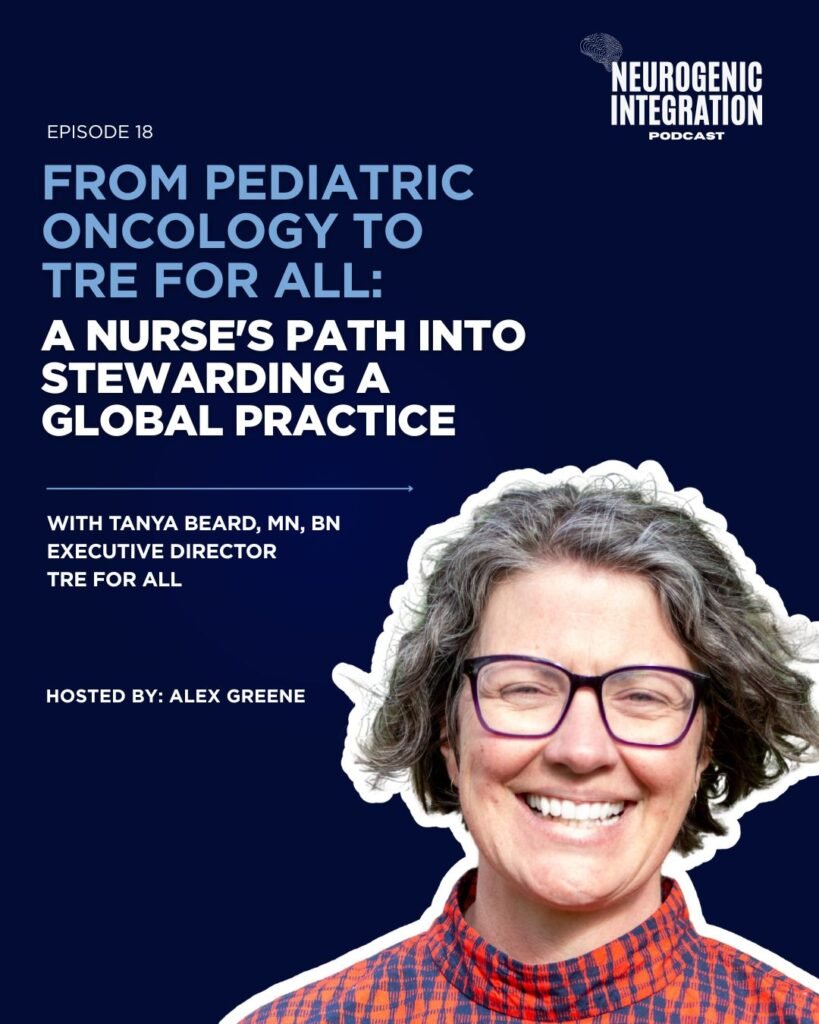
What does it look like when a body-based practice rooted in mammalian biology travels into firehouses, missionary communities, post-genocide villages, and your own living room — and somehow stays itself the whole time?
That question ran through our recent Neurogenic Integration podcast conversation (E19) with Tanya Beard, MN, BN — Executive Director at TRE for All (TFA), the global nonprofit that has stewarded TRE® certification trainings for nearly fifteen years. Tanya brings more than two decades of nursing and clinical experience to the role: pediatric oncology, child and family psychiatric care, Air National Guard and Air Force Reserves nursing, school and family consulting, and — during the pandemic — a job at her local public library.
This article is a companion to the episode. It walks through the moments we keep coming back to, with timestamps so you can listen along to the parts that resonate.
Who is Tanya Beard, MN, BN?
Before stepping into the Executive Director role at TRE for All, Tanya trained at Doernbecher Children’s Hospital in Portland, Oregon, working in pediatric oncology and bone marrow transplant nursing at twenty-two. She later spent roughly a decade as a child and family psychiatric nurse practitioner, served in the Air National Guard and Air Force Reserves, and consulted with schools, families, and treatment centers on body-based approaches to nervous system care.
Underneath all of it was one consistent instinct: bring the body into the room. Walking sessions with teenage clients instead of sitting across a desk. Yoga with families. Mindfulness, breath, movement. The instinct was there long before she had a name for the missing piece.
A “Body Yes”: From the Library to TRE for All (27:00 – 28:30)
After moving to Washington State and choosing not to renew her clinical licenses across state lines, Tanya ended up working at her local public library — running story times and community programs. She loved it. She still does.
What she didn’t expect was a phone call from Linnea Gillin — TRE certification trainer and co-founder of Yoga Calm for Children — asking her to step onto an interim board for an organization in transition.
The answer came from her body before her cortex caught up. It was, she said, a body yes.
About eighteen months later, she’s the new Executive Director — leading a small staff that serves a global community of roughly 95 certified TRE trainers across more than 65 countries, and several thousand active providers worldwide.
“Effervescence” — Tanya’s First TRE Session (07:30 – 10:00)
Years before that phone call, Tanya stumbled into her first TRE session almost by accident.
It was an optional after-hours offering at a Yoga Calm for Children training with Linnea. She’d never heard of TRE before and figured she might as well try it.
She lay down on the floor afterward, looked up at the ceiling, and felt something she now describes as effervescence — a small, bright feeling of delight she had no language for.
The first question she asked was the one that has shaped much of her career: Who came up with this?
That curiosity led her to the work of Dr. David Berceli, the creator of TRE®, and then into a TRE training with the late Susan Schiffman. From there, Neurogenic Tremoring became a regular part of her toolkit alongside the yoga, mindfulness, and walking sessions she was already weaving into her work.
What is Neurogenic Tremoring?
Neurogenic Tremoring (sometimes called Tension and Trauma Releasing Exercises, or TRE®) is a body-based practice that engages the body’s natural tremor mechanism — an involuntary, non-pathological response present in all mammals — to support nervous system regulation.
The practice was developed by Dr. David Berceli, a clinical social worker and researcher who first observed tremoring as a protective response in conflict zones and refugee populations. The exercises he developed work by mildly fatiguing specific muscle groups and then giving the nervous system permission to release accumulated tension through tremoring on its own terms — body-led, not practitioner-led.
Emerging research connects TRE to reductions in cortisol, improvements in heart rate variability and vagal tone, and benefits in conditions ranging from chronic stress to PTSD to multiple sclerosis. The evidence base is still maturing — but it’s maturing.
TRE’s “Flexible Skeleton”: Three Field Stories (42:30 – 48:00)
One of the threads we kept returning to with Tanya is what she calls TRE’s flexible skeleton — a clear shape that makes the practice teachable, and an adaptability that lets it land in radically different contexts.
There’s a scope of practice. There are standards. There are guiding principles. Inside that shape, the exercises can be modified, slowed down, layered, or set aside entirely — so the practice belongs to whichever body, culture, or community is doing it.
In the conversation, Alex shared three examples from his recent presentation at a trauma conference in Honolulu:
A peer-led model with the New York City Fire Department
Firefighters in the NYC Fire Department area have been carrying Neurogenic Tremoring to one another through a peer-led model — meeting the unique stressors of the job with a practice that doesn’t require them to step outside their own ranks to access it.
An outreach with the Missionary Sisters of the Holy Rosary in Cameroon
TRE provider Mohamed Sala led an outreach project with the Missionary Sisters of the Holy Rosary, introducing the practice to more than a thousand sisters, hospital staff, clinic visitors, and students across eleven days. Music and laughter were part of the entry point.
An ongoing project in post-genocide Mayan villages in Guatemala
TRE provider Ryan Demas is part of a team weaving TRE into a community healthcare project in Mayan villages affected by the genocide of the 1990s. When translators weren’t available, the teaching continued anyway — body to body, mammal to mammal.
This is the part of TRE that’s hard to capture in a research paper but matters enormously in practice: the work can happen even when language can’t.
“Everybody and Every Body”: Why TRE Was Designed for the Wider World
Dr. Berceli could have made TRE a clinical-only modality, taught only inside Western therapeutic structures. He didn’t.
As Tanya put it in the conversation, somewhere between 80% and 90% of the global population doesn’t have access to psychotherapy in the Western sense. Clinical frameworks like the DSM are useful in their place — and they don’t carry universal cultural relevance. TRE was designed to reach further than that, by being something every mammal already has.
It’s the heart of an old TFA tagline she still returns to: everybody, and every body.
Normalizing the Tremor for Kids and Families (around 1:01:00)
Tanya has another quiet conviction: you don’t have to convince a kid to tremor. You just have to let them see it.
She talks openly about how five decades of her own defense mechanisms made her tremor harder to find — and how the work with kids isn’t about prescribing the practice. It’s about normalizing it. Letting them watch. Letting the dog come lie next to her while she tremors on the floor.
“Maybe they’re 27 before they decide they’re gonna use one of those,” she said. “But they’ve seen me tremor.”
That’s also part of why the practice travels well into schools, families, and youth-facing programs.
How Neurogenic Tremoring Supports Leadership and Daily Life (1:10:00)
We were curious how tremoring shows up in Tanya’s own life now, especially in a role that involves a global community, a small staff, and an inbox most of us wouldn’t envy.
Her answer surprised us in its simplicity. The tremor, she said, has become so woven into her nervous system that she couldn’t shut it down if she tried. A leg releases. A breath deepens. The physiological noise settles.
In one small moment from the conversation, she describes being at a stoplight when another car nearly hit hers. She rolled down her window to check on the driver and saw him beginning to shake — that small, post-startle tremble most of us learn to suppress before adulthood. Instead of normalizing him out of it, she simply said:
“Oh, good — your body is trying to take care of that. You can shake that off.”
He shook. He blinked. He said, “Oh.” And that was it. No script. No explanation of TRE. Just permission.
It’s a useful demonstration of what daily TRE practice can offer beyond the session itself: a nervous system that works with you in real time, not just on the mat.
Where TRE for All Is Headed
Tanya described TFA’s current work through three pillars:
- Clarity — what TRE is and what it isn’t, with clear scope and standards of practice.
- Conduct and ethics — protecting the integrity of the method and the people learning it.
- Accessibility — decreasing barriers and increasing entry points for as many bodies as possible.
The organization itself is small — Tanya, two contractors, and a student intern. But the community it serves is enormous: 95 certified TRE trainers across more than 65 countries, and somewhere in the multiple thousands of active providers worldwide.
She also pointed to the research momentum. A randomized controlled trial out of Denmark on multiple sclerosis is a milestone. New studies out of China — including a parent-teen dyad RCT — are widening the picture. The evidence base is still maturing, but it’s maturing in the right direction.
Why This Matters at Neurogenic Integration
At Neurogenic Integration, we love this method because of its quietly radical proposition: your body already knows how to release tension. That same proposition is what makes Neurogenic Tremoring travel so well across cultures, settings, and skill levels. The work doesn’t require a particular spiritual framework or a particular diagnosis. It depends on something every mammal already has.
We came away from this conversation grateful — for Tanya’s care, for TFA’s stewardship, and for the providers and trainers around the world who are quietly doing this work in the places that need it most.
Frequently Asked Questions
What is TRE for All?
TRE for All (TFA) is the global nonprofit that oversees TRE® certification trainings worldwide. Founded by Dr. David Berceli to expand access to Neurogenic Tremoring, TFA stewards trainer certification, provider standards, and accessibility initiatives for TRE communities in more than 65 countries. Learn more at treglobal.org.
Who is Tanya Beard?
Tanya Beard, MN, BN, is the Executive Director at TRE for All. She is a former pediatric oncology nurse, child and family psychiatric nurse practitioner, and Air National Guard / Air Force Reserves nurse, and a certified TRE® provider trained by the late Susan Schiffman. She is based in Washington State, USA.
How is Neurogenic Tremoring different from psychotherapy or somatic experiencing?
Neurogenic Tremoring is a body-based practice that uses the nervous system’s own tremor mechanism. Unlike talk therapy, it doesn’t require verbal processing — and unlike many somatic modalities, it doesn’t require a practitioner to lead the release. The body initiates and regulates the tremor itself, with a trained provider as a guide rather than a director.
Is Neurogenic Tremoring safe?
When practiced gradually and with appropriate guidance, Neurogenic Tremoring is considered safe for most adults. As with any body-based practice, individuals with specific medical conditions, recent surgeries, or significant trauma histories may benefit from working with a certified TRE® provider rather than starting on their own. If anything causes pain or discomfort, the exercises can easily be modified or set aside.
How do I start a Neurogenic Tremoring practice?
The simplest place to begin is with a guided introduction. Our live online classes at Neurogenic Integration welcome complete beginners, and our Foundations Course offers a deeper, self-paced entry point. From there, those interested in becoming TRE providers can explore our online certification pathway.
Listen to the Full Conversation
This article only covers the surface. The full episode covers Tanya’s unlikely path from pediatric oncology to TRE for All, the field stories shaping the practice today, the research moment ahead, and how tremoring supports her leadership in real time.
Listen to E19 on the Neurogenic Integration podcast.
If you’d like to experience Neurogenic Tremoring for yourself, here are the simplest next steps:
- Join our live online classes → https://neurogenic-integration.com/webshop/#classes
- Explore our Online TRE® Certification → https://neurogenic-integration.com/webshop/#cert
- Learn more about TRE for All → https://treglobal.org/
Transcript:
[00:00:00]
Alex: All right. Well, hello everybody. I’m excited to be sitting down this afternoon with Tanya Beard. And Tanya is a TRE provider and also a nurse practitioner, and some other things she’ll tell us about. But most centrally to today’s conversation, she is the current — and somewhat new — executive director of TRE for All, which is the global NGO, or nonprofit organization, that administers TRE certification trainings.
And those of you listeners to the podcast Neurogenic Integration, you know we talk a lot about tremoring and TRE. And so TFA, or TRE for All, is the home of much of the activity that we see all around the world. So I feel very honored to have Tanya on the show today. And what I’d really like to hear from Tanya is a lot about kind of her own personal story.
Everybody has gotten drawn into neurogenic tremoring and TRE usually for our own personal reasons. [00:02:00] And so I’m gonna want to know that sort of story from Tanya. But then also, in her central role within the TRE for All organization, what kind of work is happening now and what sorts of opportunities are coming as we — collectively, tremorers around the world — as we sort of shape this modality and how it works in today’s world.
So that’s kind of what I’m hoping that we cover today. Tanya, thank you so much for taking time to sit down for a conversation.
Tanya: Yeah. You’re welcome, and thank you. It’s been fun to get to know you a little bit too, coming into this community and meeting so many wonderful people a little more deeply.
So absolutely. I guess if we start with my story — yep, like you said, I was a nurse practitioner. I retired from that career. I guess if I go back, before that I was a nurse — bedside nursing. So a lot of very intense situations. [00:03:00] Mostly in pediatrics, so families. A lot of crisis. You know, when children are hurting, it really brings out the best of us.
I’ve worked in adult medicine and I’ve worked in pediatric medicine. There are differences. A lot of people would wonder, you know, how do you do pediatrics? And I thought often that pediatrics is so much more all-encompassing. You’re really in the moment, really trying to focus on the child, make sure that they’re okay. It’s like everything else in the room goes away.
And so, starting there — my first job was in pediatric oncology and bone marrow transplant. And I was young, I was 22 —
Alex: Was this in — ’cause now you’re in Oregon, is that correct?
Tanya: Washington now, yeah.
Alex: Oh, Washington now.
Tanya: That was in Oregon. So I got the one spot in my senior year. There was a clinical spot at Doernbecher Children’s Hospital for pediatric oncology and bone marrow transplant. [00:04:00] And I did — I would say I did everything but beg. But I think I did beg for that spot. I would see my teacher on campus, and I would walk by her and cough and be like, “Pick me. Yeah, peds oncology.” And she was like, “I, you’re so annoying. You’re so annoying.”
But I did get it. And then I was lucky enough to be employed there. And so I was 22, you know, working with children with cancer. Children of all ages — the youngest was three months, the oldest was obviously in their 20s. And then did some work with adults from there and kind of traveled around in nursing.
And then I was a child and family psychiatric nurse practitioner for about 10 years. All-encompassing, probably around 20 to 25 years. [00:05:00] Did some work as a consultant, and then moved to Washington. And my nurse practitioner journey ended because we moved the year before COVID.
And so I had — you know, when your licenses are state-dependent, and there are some licenses that have a multi-state pact, and I didn’t have one of those. So I’m looking at moving to a new state, getting the children — I have two kids. And they were in middle school and early elementary school age, and I was like, “Nope, this isn’t gonna happen.”
And I just, Alex, I just let it go. I let the licenses go. I let my RN license go. I let my nurse practitioner license go, and I just kind of hunkered around the family, so to speak. And I was a mom. I was just being a mom for a long time, which oddly is the hardest job I’ve ever had.
Alex: Yeah. It’s intense.
Tanya: Yeah. So we did that, got through the pandemic, and somewhere along that journey I was realizing — I don’t want to say the limitations of psychiatric medication, because I think that they are extremely helpful when they are, and I think it’s a wonderful tool. [00:06:00] Sometimes I hear psychiatric providers say that medication is the limitation. I think — maybe for me it wasn’t that I saw medication as limited. It’s that it wasn’t the fun. It wasn’t the most engaging and fun tool for me. I was good at it. It’s a pretty straightforward, methodical, evidence-based —
Alex: You were a prescriber — like you prescribed.
Tanya: Yeah, yeah. Did counseling, did some basic mindfulness, and just like the regular suite of complementary, accessory, adjacent — you know, how does it feel to just sit in silence and breathe for two minutes? Okay, you can’t do that? All right. That kind of helps you gauge where you’re at. Two minutes of silence can really help people gauge where they’re at early in their adventures with stress.
So I started thinking about yoga, and bringing yoga to kids, and I found a lot of people who were doing that. And you start adding tools to your kit. And that was really fun because I liked the movement piece.
I always would take my teenage clients out of the office. So they’d come in for their psychiatric med management, they’d come in for their counseling — [00:07:00]
Alex: Yeah. We’d go for a walk. Oh, cool. Bilateral, right?
Tanya: Yeah, yeah. It just was — I was such a body person from the start. So we would walk, and then I found out that that was, you know, like an evidence-based practice.
Alex: Practice. Yeah, exactly.
Tanya: So just kind of intuitively, following my body of work, was into movement. Yoga with kids, making it fun for them. And then I would have parents come in that wanted to do yoga with their kids, and I was terrified I was gonna hurt a parent. ‘Cause kids are bendy, and —
Alex: Kids are limber.
Tanya: Yeah, yeah. And I’m looking at adults and I was sweating, and I was like, “No, I can’t do this.” [00:08:00] So then I learned to teach adults yoga, you know, in this very accessible, basic, entry-level way, just to try to make space for families to move together.
And so — it was one of those trainings that my mentor had us — at the end of the day she gave us an optional, “It’s just optional, since you’re here staying on the site, if you want to try TRE.” And I did. And I thought, “Why not?” I literally thought, “Eh, why not? I’m staying here. I may as well.” And I had never heard of it. I had no idea what it was.
And so I did the TRE exercises. And I just remember — I have a visceral memory of laying on the floor and looking up at the ceiling and just thinking, “What is this?” This feeling of — it was like a feeling of — I’ve written about this before, and people have probably read it if they’ve ever read anything I’ve written, but effervescence. A little bit of effervescence.
And it was a feeling of delight. [00:09:00] What the heck. And this is curiosity, right? So brimming with curiosity. And then I immediately was like, “Who came up with this?” So I started researching who had come up with it.
My spouse has always called me an omnivore. I’m voracious. You know, if I learn about something, I want to know more about it.
Alex: I think we have that in common.
Tanya: And so I learned about David, learned about his story, and I thought — well, if my experience is — you know, in all these stories I just told you, those little micro run-throughs of my experience as a nurse — there’s so much pain, right? And so much nausea and so much suffering and stress and tension.
And I thought, okay, so if the common factor is that after things happen, there’s the time for recovery and rest and reset. And that part was always really, really appealing to me. [00:10:00] How do we coexist while we’re in this?
As somebody who’s incredibly empathetic, I also just have that sincere desire to — you know, you’re giving pain medications as a nurse. You’re literally giving pain medications sometimes when people are in pain. And sometimes, Alex, there are moments where no matter what medication —
Alex: You’ve maxed out what we can give.
Tanya: Yeah, right. Maxed out, not doing it. There’s nothing else you can do, and you’re sitting. And then it’s just you sitting with somebody, very young, you know, who’s in intense pain.
So I thought, “Okay, interesting.” So these are all experiences. You kind of go out on this branch, and then you come back to the trunk. And TRE is [00:11:00] so accessible and it’s so simple, and it doesn’t require, you know, a specialty medication visit. It’s something you can do when you’re with people, it’s something you can do when you’re alone. You can do it in the moment.
Once I did the TRE — once I did the TRE and had access to the tremor mechanism again, my own innate ability to shake it off in the moment — it kind of becomes part of you.
Alex: Well, just interjecting briefly — you know, you’re talking about the environments that nurses are in. It’s bringing me back to before the pandemic, before I moved to Colorado, when I was based in Madison, Wisconsin. And I was doing a mix of TRE and structural integration bodywork. And for about five years, it wasn’t like all my clients were nurses, but that was the category of person that I had the most.
I went through this period where I learned how much nurses are exposed to in terms of secondary stress, trauma — and especially, I mean, of course doctors, everybody’s got their own version of this, but I learned how much nurses [00:12:00] are exposed to. And when I found TRE, for a while I was on this mission where I was doing a lot of work with nurses in the UW Health System. Where, you know, this was through invitation, but where the nursing staff and related were really valuing TRE. And some of them ultimately became providers and used it in patient care, but just for the nurses themselves as a tool.
And I’m remembering all this as I hear what you’re sharing.
Tanya: Yeah. Yeah. It’s wild, you know? I think nurses — and like you said, there’s so many players in the field of the care and keeping of humans. All are relevant, all are important, all are vicariously taking on the stress and the trauma and the [00:13:00] machinations of the system, the healthcare system. All of that. It’s just very intense.
But you know, I got such an insight into nursing when I was a patient for the first time.
Alex: Okay.
Tanya: So I had been a nurse at such a young age. I hadn’t had children yet — you know, I didn’t have any children until I was in my 30s. So I’m taking care of little babies, and in a lot of ways, that helped a lot because it’s very procedural. It’s very immersive. I always would tell people, “I’m up to your elbows sometimes in someone’s suffering.” You’re really in intimate space with people. While trying to respect dignity and boundaries — all of this is such a fine balance of so many things.
And then I had the unfortunate experience of being kicked in the — I think, have I told you the story about how I got kicked in the face by a horse?
Alex: You’ve alluded to it. But never where we had enough time for me to really understand this.
Tanya: Okay. So yeah. I like challenging things — which we’ll get to the executive director role later. [00:14:00] I like challenging things. I like backpacking, I like skiing fast, I like doing all these grueling things. And I had a bad habit when I was younger of picking horses that I had no business —
Alex: Riding.
Tanya: Working with. But it was just a thing I did. It was — I really enjoyed it, and for a lot of years I worked with a lot of horses that were, I don’t know, maybe they were just challenged. They had various challenges. And this horse and I got along really well. But one day, a myriad of things happened that just resulted in her pushing into my space, and I pushed her back. I’m like, “Hey, hey.” And she just shot forward and kicked me right in the face, right on the chin.
Yeah. There’s a — like, normally, healthcare providers — I know so many ER doctors that would rather just take care of something themselves at home than ever go into the ER, and I think a lot of nurses are that way too. You cannot self-care a broken jaw.
Alex: No.
Tanya: You just cannot. [00:15:00] And so I ended up going in, and then ultimately had to go back in and get the jaw wired shut and all of that.
And so I’m in — you know, it’s time to leave and go home, and I couldn’t. I was panicking because my jaw [00:16:00] was wired shut, and I woke up from the anesthesia in a not great — it was the panic. And I’d never had that experience before, so I was like, “Wow, this is different.” Usually I wake up from anesthesia giggling and cackling and telling jokes — and that’s much more what I’m used to. But I was panicked.
And so I ended up staying the night rather than going home, because they had to put me back out a couple times. And so I’m sitting there, and every single person that came in my room — first of all, it was very difficult for me to start walking, be like, “Oh, the IV pole, I have to take that with me, right? How many times have I walked the IV pole?” I just tried to walk away without the IV pole, and I’m like, “Wait a minute. This is very odd.”
And whenever somebody came in to do anything at all — start an IV, anything — they would say, the nurse would say, “Ooh, did I hurt you?” And I thought, “Oh, we have this job where we literally hurt people all day long [00:17:00] while providing care.”
Not all of the time, but often. We’re doing these things that harm. And so it was so interesting to see everybody so flinchy that they might have hurt me. And I thought, “You’re fine. You’re taking care of me.” And I realized the impact of that alone. Just seeing that hesitance to hurt people while taking care of them.
And I thought, “Wow, what a weird juxtaposition.” That gave me a big insight. So I do think that the caretakers, the nurturers, the procedural — even — I’ve known some people who aren’t very nurturing or caretaking in their nature, but they’re really good at the procedural part, or they’re really into the anatomy, and they’re wonderful clinicians.
And the toll of being the person who’s inflicting discomfort onto people, even just that alone — I could feel it in their bodies. ‘Cause like I said, in TRE and a lot of body-based methods, [00:18:00] what we talk about is the tension — the shoulders coming up and the “Ugh, ee,” the “Aah,” the tension.
So that was interesting. And it changed my perspective a little bit. It was interesting —
Alex: I imagine — the first time you’re a patient, yeah. Well, okay, so you mentioned that your first TRE exposure, you had no idea what it was. So I’m guessing — was that with Linnea and Jim?
Tanya: Yeah. It was at a Yoga Calm for Children training — one of the trainings. And I had stumbled into that because I was trying to figure out how to help people just breathe. ‘Cause we can do medication, and we can do counseling, but a lot of people that I was sitting with just couldn’t breathe.
And so I was like, “Well, what if we start to figure out how to combine these things and bring in the body?” But yeah, it was Linnea.
Alex: Cool. Yeah, it was wonderful. Well, so once you had your first experience and it was so interesting for you, and then you looked, “What the heck is this thing?” — like, did you start doing it for yourself? [00:19:00] Did you — how soon between that and deciding you wanted to train in it? What was that timeline like?
Tanya: Yeah. Any time that I experience something that — this is gonna sound really funny — but that just feels like it lightens the human experience — as somebody who navigated my way to the level of being a nurse practitioner, that advanced, advanced care — I want to be able to share it.
I think all of us, if we can, in community, try to lighten each other’s loads as much as possible together, collectively, just sharing any tools. And so I just wanted to share it immediately.
I have a habit of any time that I find something new, I want to research the roots of it. I want to see what’s it adjacent to, what informed it, where did it come from. I want to see the lineage of it. And so you could see [00:20:00] where David’s — Dr. Berceli’s — very natural curiosity, of just observations in real time, and getting curious about something, and then looking at how that all influenced.
I was captivated by how he saw something, he got curious about it, and he created something so simple. And I thought, “What a wonderful thing.” So I felt like his story was good. And I got to know him a little bit through reading about him, watching some of his videos. And that was enough for me to feel like, “Okay, I want to learn this.”
And then I found my way. My trainer was Susan Schiffman. So Susan trained me, and that was a wonderful experience. Susan’s gone now, of course. She had this light in her eyes. She was a very interesting woman. So I learned [00:21:00] her very gentle, and just a very simple version of TRE. Gentle and simple. Nothing added on, nothing exciting.
But what she said too was that — you know this in your practice — combining methods or sequencing methods with TRE, it complements other things so well. And so Susan would say, you know — we try in the TRE world to be really clear: this is TRE, this is not TRE. If we’re blending models or doing a workshop, just being really clear. But she always was really clear with me that the mixing is where the fun begins.
You can have some fun with TRE. So I liked that. Because I’d been already working with yoga with children and adults, mindfulness, asana, all the different things, medication, all the things you do when you’re trying to prescribe medication — like diet and lifestyle. It just was such a good complement. So it fit right into the toolkit. [00:22:00] It played into what I was already doing.
And the more people I met, the more — TRE has attracted such an interesting community of people. Really, really curious people. People who, much like myself, ask, “How do we do this together? How do we all do this together?” So yeah, it just fit. It fit at the time. It was great. And it’s given me —
Alex: So then was that after you moved to Washington and you had stopped being a nurse, or was this still when you were nursing?
Tanya: Still when I was a nurse practitioner.
Alex: Okay. I see, I see.
Tanya: Yeah. And then I had — Alex, then I had this interesting shift from psychiatry, strictly psychiatry, into population health nursing.
Alex: Okay.
Tanya: And we’ve talked too, all along the way, that I had been in college when I was in nursing school — I was in ROTC.
Alex: Yep. We talked about that.
Tanya: And I was in the National Guard at first.
Alex: Yeah. Actually, it’s a very weird story. I had a pilot slot. [00:23:00] And I was thinking about being a pilot, and then I was thinking about, “Can I be a pilot and a nurse?” And people were like, “Well, you could, but well…” And I was like, I could. If anyone could, it would be me. I would do it.
And I was like, “No, can’t do it. I can’t do that.” So I gave up the pilot slot because I wanted to stay at Doernbecher. I love taking care of children with cancer. It was such a wonderful time for me. So I gave that up. At the very last minute, they opened up some Air National Guard slots. So I had given the pilot slot back, and I waited till the last minute, so I couldn’t get a nursing slot back. So I got the Air National Guard spot as a nurse.
Did just mission readiness — keeping people ready to go, to deploy wherever they would need to in the state. And then I shifted to the reserves, the Air Force Reserves. It was in Colorado, in Alaska, kind of all around. Women’s health, pediatrics, just a few different things. But I loved that.
And so then I was looking at some of the experiences I had in the military, [00:24:00] where people have profound trauma from deployments — what people I think don’t think about often is that we elevate and therefore sometimes dehumanize veterans and military service people. We think of them as these characters, and they’re just people like us too. They are people. I was a people too. And all of the military members that I worked with and were friends with — a lot of us had our own issues separate from things that we accumulated through the military work that we did, whether we were overseas or deployed or active duty or not. It’s a system.
And so it lent really well to that too — to my military friends, the athletes. The military is so physical. You’re doing so much weightlifting and just exercising all the time. Yeah, yeah. So it just touches on so many things.
So that was lovely. So I started doing consultant work. Consultant work around — okay, [00:25:00] I feel like because primary care has gotten so bogged down, and there’s a lot of healthcare provider shortage areas, that the things that used to happen — just teaching basic self-care, basic preventative care, basic lifestyle care — has become inaccessible because there’s not necessarily time for it in the sessions anymore with your healthcare team.
Alex: Right. Yeah, exactly.
Tanya: And you kind of can’t bill for it. The model shifted so significantly. It’s not — yeah, fair point. Now, in some places you can, and in some ways that you can, but we’re kind of trying to hold on to an archaic model. I was in medicine when the care shifted from preventative to tertiary.
And so I thought, “Okay, that has fallen off. I’m sitting here doing specialty medicine to try to get people to look at the basics, and then add the specialty medicine in.” So I just started focusing on the basics with people. And then adding in things like TRE and [00:26:00] different ways of communicating as families.
And so I was working with schools, I was working with — I tried to go to the places where things were happening that were leading to kids coming into my office, right? Families, schools, treatment centers, et cetera. And so I started doing a lot of consultant work, and I loved that work — helping teachers understand how to take a step back, cover the heart, engage from a cortex place. ‘Cause teachers are overwhelmed too. And so really looking at all the industries — where kids go — that are just beleaguered and burdened and exhausted. And trying to help on that level as well.
And then we moved. So in Washington — you know, what happened between leaving Oregon and leaving that consultant practice and that population health level, working in schools, coming to Washington — pandemic happened. And I’m working with my kids and learning about alternative education models during COVID and all of that, just like everybody was. [00:27:00] Trying to scramble and figure it out. Trying to find our little COVID pods and bubbles and stay safe, and how do we figure this out, and what are we gonna do?
And then I didn’t want to go back to medicine, not because I didn’t love medicine. I loved the practice of medicine. But once you step away from that model and you take a significant time away from that model, going back in — first of all, there are a lot of barriers to re-entry, unfortunately. And so I thought, “Do I — how bad do I want it?”
And I got a job at the library, Alex. I just went and got a job at the library. And so I was working at the local library, the public library, and I loved it. Was on the community engagement team, doing baby story times, family story times.
Alex: Like, we, as a family — I have two young kids — as a family we heavily lean into our local library for story time and all of the above.
Tanya: Yes.
Alex: I appreciate the people like you who put on those programs.
Tanya: Yeah. It’s so fun, and so many different community events. And the thing too is that libraries have become not just the place for books and research, but kind of like a town square. [00:28:00]
Alex: Very much. Yeah, definitely so.
Tanya: So all of my skill set kind of lent into that. And so I’m sitting there with all this — this whole story I’ve been telling, this eclectic set of skills — and leading into Linnea calling me and saying, “Tanya…”
Alex: Yeah. Well, so when was that? So locate us in time.
Tanya: Yeah. It was — that was about a year and a half ago. I think it was, like, September, October.
Alex: That short? Feels like it was, like, two decades ago now. It feels like I’m 100 years old now.
Tanya: I feel like you and I have just met, but this is, like, when you meet under intense —
Alex: We go way back, yeah.
Tanya: I’ve known you four weeks. It’s been about a year and a half.
Alex: Okay.
Tanya: And I had started helping Linnea with her trainings. And just so everybody knows — Linnea Gillin is a TRE certification trainer, and also she runs Yoga Calm — she and her husband Jim run Yoga Calm in Portland, right? [00:29:00] Yoga Calm for Children. Out of Portland.
Anyway — Linnea is a visionary. And, much like Dr. Berceli — you know, we meet people and they just have these great ideas, and they kind of pave a way. Using something as brilliant as yoga in the rural Oregon setting in schools at the time that she did was unheard of. And just bringing it in for kids — it was amazing.
So I love these people that are courageous and curious — “How do we do this a little bit differently?” And here we are. So Linnea and I have always gotten along. My interest in pediatrics — I’ve really learned a lot from her over the years. And Jim is just hilarious, and a sophisticated, intentional person with how he teaches yoga [00:30:00] to avoid injury and to increase the accessibility.
One of the things I’ll never forget — I always hear in my mind — is, “Bring, raise the floor up.” So how do you raise the floor up? Add blocks or things, so that when you’re trying to touch the floor, you raise the floor. And that fit in with — another person I’ve always looked up to is Maria Montessori, the Montessori school model.
Alex: Oh, yeah. Yeah. I taught in a toddler classroom, a Montessori toddler classroom.
Tanya: Yeah. You know, so just that — make the work smaller. If it’s too big, make it smaller. And increase accessibility and entry points. And I think that’s my mindset overall: decrease barriers, increase entry points.
So Linnea’s known all this about me, and I was thinking about being a trainer. I was thinking about thinking about being a trainer. And so I asked Linnea, I said, “Would it be possible to [00:31:00] kind of tag along a little bit and just sort of learn?”
Reiterative learning, I love. Just listening to the same thing — you always get something new. And so yeah, I was riding along, mentoring a little bit, assistant teaching and learning. And of course, during the pandemic, TRE training went online.
Alex: Yeah.
Tanya: And so I got to ride through that transition — yeah — and help with that. And I know that it was a scary time, it was an uncertain time, and it was wonderful. I think it surprised all of us how well it went. You know, and I know different people have different perspectives on that, but for me, having been a part of that, it was amazing how community can be created through the digital tools.
Alex: Yeah. No, I had the same. Like, “Wow, I can’t believe how well this can work.”
Tanya: Yeah. And then doing TRE with people remotely, [00:32:00] and seeing what was possible — that was really interesting for me. You kind of learn, like, “What is humaning?” I was like, “What is humaning? Wow.”
So, you know, then it’s October. TFA — TRE for All, we call it TFA — was going through some things, and I was very blissfully unaware. I tend to kind of just stay to my own little circle. I always think: these four people, these four walls, this dog, these two cats — that’s my business. Stay in my business.
And so I was minding my business, and Linnea said, “Would you…” And immediately I did this — because any time anyone says, “Would you like to be on a board?” — my, it’s a — nonprofit work is very, very, very intentional and purposeful and intense.
Alex: Yeah. It’s a lot of work.
Tanya: It’s never just “be on the board.” So I laughed, [00:33:00] and I said, “Linnea, you have brought so many things into my life that have changed my life for the better that I will say yes.” I said, “If it was anyone but you, I would’ve said no, but I’m gonna say yes.”
And I felt it in my body too, Alex. ‘Cause I’m one of those people — I’m almost 50. Like, feel it in your body first and then answer. Don’t just say no or yes — just feel it in your body first and then answer. And it felt like a yes. And I don’t know that I, in my cortex, agreed with this yes. But it was a body yes.
So I knew that that was a path I was going to go down, so I said yes. And there was a little interim board that had been assembled to just sort of ride through a transition.
Alex: Yeah, the former executive director was leaving, and a kind of new era got ushered in.
Tanya: Yep. Yeah. A time of uncertainty. So I joined that crew, and we sat on the board. [00:34:00] It was such an interesting thing because we didn’t know. We were joining to help. It was so much listening to so many voices. And we’ve talked about, like, “What is the scope of TFA?” It’s the certificating body, the nonprofit to increase access and decrease barriers to TRE around the globe.
Alex: Yeah. So it’s — yeah. Well, let’s pause for a second, because I think that might be a good thing — just context for listeners. Like, let’s just talk a little bit about TFA. When did it begin? We don’t need all the history, but just the bullet points of TFA. What’s its mission? [00:35:00] Like, what would be your elevator description of what TRE for All is and its work in the world?
Tanya: Yeah. I think — so I want to — from what I know, from what I can tell — around 15 years ago, Dr. Berceli started the nonprofit to just do that: to increase access to TRE around the globe. To make TRE available.
And I think Dr. Berceli was the director for a time, and then of course he travels all around. He always says he’s taken TRE everywhere but Antarctica. And I think he’s made jokes about, “I would go there too.”
Alex: We need someone to invite him to McMurdo.
Tanya: Yeah, yeah. So that was his work for a time. And then the director before me — she went through, I think — how long was she there? Eight to 10 years. Quite a while. Not as a director all that time.
And so there’s a trainer community. [00:36:00] I think we’re up to 95 trainers now.
Alex: How many countries?
Tanya: Oh, you know what? I haven’t gotten to that yet. We’re — I haven’t got to that part yet, but it’s on my list. Like, how many countries? So it’s many. I mean, it’s at least — I’m confident 65 is a floor.
Alex: Yep.
Tanya: But — I mean, I trained a few people in Iran this year. That might be a new country. There’s a chance that we’re pushing 70. We’ll see. We should add it up. That’s a big thing. It’s beautiful. You know, it’s funny when you’re a director, you start to look at all these silly things like, “What metrics?” Because those are the things you need to know when you’re partnering with other organizations. Like, “What do we do? What’s the scope? What’s the reach?” All those things.
And so, yeah, that’s one of the inventories we need to do — which countries. And the other question is, we don’t know, over the 15 years, how many providers we have. We’re in the multiple thousands of providers.
Alex: Oh, yeah, easily.
Tanya: Yeah. That would be a good thing to know the minimum of.
Alex: I mean, it’s gotta be at least 5,000, I would think. That’s a projected 5,000. Some people are in [00:37:00] the maybe 8 to 10,000 range. Their best guess. But I try not to pin the tail on the donkey’s behind this.
Tanya: Yeah, we don’t know with total confidence.
Alex: Yeah, yeah.
Tanya: But multiple thousands of providers. And so Dr. Berceli’s goal was get TRE to as many people as possible. To everybody. And I think for a while there was a tagline of everybody and every body — to make sure that the exercises are accessible for every body. Because, as we know, when you look at different bodies, the exercises — we can modify them. We can make them more accessible. We can just set one or two exercises aside if we need to, if anything causes pain or discomfort. Skip it, go to the next one. So they’re easily modifiable.
And so just getting it out, and making it — I don’t like the word owned, but it’s the one that’s coming to mind, so I’m going to use it — owned by the people. If you’re in a community, [00:38:00] how do you make it come to life for that community? For them.
Yeah, and how do you — depending on what the needs are — I’ve done a lot of community outreach. So in a day, groups I would go visit, you would need to modify it. So I think it’s — we always talk about — you’ve heard me say this before — the flexible skeleton. Like the core of “yes, there’s a scope of practice; yes, there are standards and guiding principles” — and TRE has a flexible skeleton.
And I think that’s one of the things sometimes — we should talk about that at some point today, because —
Alex: Yeah, we will.
Tanya: I think we should get to that later. But it has a shape. TRE has a shape. And it can take further shape depending on the context. And that’s the part I love about TRE too, because it’s innate to mammals. [00:39:00]
Alex: Yeah. Well, I mean, you know, I’ve heard, you know — when I introduce TRE — it’s like something I always like to share. Dr. Berceli, he had all the credentials, as a clinical social worker. He could have made this a clinical-only modality exist where psychotherapists are the people learning it. But, you know, I’ve heard him say a number of times, “80 to 90% of the global population doesn’t have access to psychotherapy in the Western, sort of form of that.” 80 to 90% do not have access to that.
Okay, so could this — I think his vision, my understanding of his vision is, could this be something that transcends — I mean, it’s used in psychotherapy, that’s great. But if it was restricted there, how far can it reach? Could this be something that finds its way into many more people’s [00:40:00] bodies than that?
And so that’s always inspired me.
Tanya: Yeah. Yeah, I love that. Well, and the first thing that comes to mind too — having been in a field that was Western medicine modeled, right? Medication and all of that. The DSM — the Diagnostic and Statistical Manual of Mental Disorders — all of that structure, while very helpful and valid, does not pertain to the whole world. Those are constructs that don’t have cultural relevance in a lot of —
Alex: Or they don’t have universal applicability at all.
Tanya: But — unfortunately, clinical language is pathologizing. Not in the intent always, but in the impact, yes. We have become a tertiary care illness-treating medical system. [00:41:00] There are many, many reasons that has happened over the years. Like I said, I was — I’m old enough to have been part of medicine when we did paper charting, and when we did preventative care before HMOs and all that, which is really funny to me, but it’s true. And so I saw the changes that happened in the medical field.
You know, I could get really philosophical about all of that, but if we just stay focused on that — this is just something that is separate. It’s separate from. And so we can superimpose. We can put layers over it. We can shape it. We can add to it. We can construct it. We can lens it. We can framework it. But really, it is — you could do it without language.
Alex: Right. You can. Well, when we get — I mean, maybe we’re already into the topic we said we’d talk about later. [00:42:00] Like, I was just in Honolulu, right? I was at the IVAT conference, which is the Institute on Violence, Abuse, and Trauma. So it’s gonna be going on 26 years, in Honolulu. Mostly social workers is the audience.
It was kind of fun for me because I got to — what I did is I really boned up on the research in a way that I haven’t recently, so I got much clearer about kind of the last several years of research. But the thing that was sort of the heart of my presentation — which was an introduction to TRE and how it can be used in various settings — is, I chose three case studies that to me felt like examples of where we can show the flexibility of how TRE can be used.
And the three case studies: one was working [00:43:00] with the firefighters in the New York City Fire Department zone, who over the last several years became interested. And what we talked about is how the deployment model was, as much as possible, to let them do a peer-led model, where they could be the ones to deliver it. Okay, so that was one example.
The other example was with this Catholic organization overseeing missions throughout Africa. And bringing — and how Mohamed Sala brought TRE to Cameroon to the Missionary Sisters of the Holy Rosary group. And in 11 days, introduced TRE to something like 1,200 to 1,300 people. In clinics, colleges, staff, hospitals — the sisters, the missionary sisters themselves. [00:44:00] So that was the second case study.
And then the third one was a new one for me — an ongoing one — which is, there’s a TRE provider, Ryan Demas. He’s in New Mexico. And he has been part of a project in Guatemala working with Mayan villages — Mayan-speaking villages whose whole region went through a genocide in the 1990s. The way they’ve constructed their project — they’re addressing — and that genocide has been largely unacknowledged, and then they also have gone through what they call an epistemicide, which was a new word for me. Which basically means that their means of understanding — their indigenous medical model of healers, the plants that they grow, their healing systems — all of that was intentionally disrupted by the state [00:45:00] as a way, as part of the genocidal intent of these acts.
Well, so in any case — Ryan, the provider I referred to, has several times now — he’s part of a team of people that do a community healthcare program that connects to acupuncture. He’s an acupuncturist, and there’s this whole other component. But he now recently started bringing in TRE in the last several visits.
And what I really highlighted in this model, coming to something you’re saying right now — there were several examples of where — yeah, they have translators, you know, many of these people are speaking Spanish, yes, but also their Mayan language. But there were times when the translators weren’t available. Well, did that stop them? No. They still continued to deliver. So this idea that, of course there’s lots of times things that we want to share verbally, but it’s also something we can teach human to human. And words can diminish in their — [00:46:00] you know, it’s not always as important.
And then, to me, the most wonderful thing about their whole project is that — after everything was said and done, they spent a lot of time asking the indigenous healers (because some of them are still there) how they understand and conceptualize tremoring and acupuncture — ’cause they’re working with both modalities. How does it fit within their own traditional worldview, Mayan worldview?
And they did 20 ethnographic interviews, because part of the scope of their project is this cross-cultural piece. And again, in the spirit of — so I especially honed in on that last example in my talk, because to me it was such a useful example of, here, you know, tremoring has existed in lots of forms. [00:47:00] Dr. Berceli always said he didn’t invent this. He just found one — he saw it in his own scope, and then developed his own methods.
And then of course, we learn that it has popped up in — it’s probably existed in one form or another in all indigenous contexts. So this idea — you know, you’re talking about there’s a core of it, but then there’s this adaptability. And that’s what I was trying to convey in this conversation.
Tanya: Yeah, yeah, yeah. No, that’s beautiful. You know, when you talk about — I have friends from many different indigenous regions. Being present while that recovery and healing is happening is — I think it’s one of the most important places to learn. [00:48:00] Because — and I think today when we were getting ready, you know, I had a crazy day, and I was like, “What do I really want to talk about?”
I think that when we talk about that example of people who’ve experienced genocide and this epistemicide — I have friends who are trying to reclaim bits of language that was lost. I have learned so much from those friends. I have so much knowledge crammed in here, and so much research, like I said. And when I set all of that aside and I think about what I’ve learned from my indigenous friends, my Native American friends, people from all different cultures — the way that we are with each other when we set aside words, knowledge, ideas, hierarchies — [00:49:00] the fact that we can find something, like Dr. Berceli said, that is innate to all humans regardless of culture, regardless of language, regardless of gender — all the categories, how we try to structure things up — if we take all those aside, it’s something that all of us are able to do. To just, phew.
When the kids were little, I wasn’t trying to teach my little kids to take a breath. I was like, “Take a phew,” and they’d go, “Phew.” So we can all take a phew. We can all just take a phew.
But it is such a beautiful, and — I don’t know what words to use, but it feels like a very rare privilege that not a lot of us get to be in those type of settings. And so when you are able to be in a setting where reclaiming of lost practices is happening, and you get to [00:50:00] listen — I think I’ve talked to you, what I was going to say is, then we have this loud, fast-moving, noisy influencer world. And I do not want to talk bad about influencers, because — put all the judgment aside, but —
Alex: You’re talking about, sort of like, the Instagram wellness space?
Tanya: Yes. All of it. Yeah. ‘Cause I think I was using the word earlier — like, intersection of healthcare and wellness and healing, and the appropriation and misappropriation of indigenous and cultural practices. That’s just — there’s so much going on. And because people have this vigor and this — I want to say almost desperation — to feel better, to heal. Which is what I said: I want to bring in feeling better and spread that, any moments we can find joy or warmth or delight. Like, any moment I’ll — good, good stuff when that can be shared.
So then we come [00:51:00] around to this almost frantic point in time where so much is going on that is so difficult. And, dare I say, there are some really bad things happening right now. Very, very, very challenging. And scary. It’s a scary time.
So then we’re bringing in these gentle measures that I think have somewhat been a — like, I think about TRE specifically, and, you know, with TRE for All — our mission being to clarify, to increase accessibility, to decrease barriers, to make sure this is safe and scaffolded, and not overly rigid, and just able to go where it needs to go and be where it needs to be.
There is — one experience, which is being in a setting where this intense healing is [00:52:00] happening, and people from different cultures can do it without talking. The — I don’t know — what percentage of language, or communication, is nonverbal?
Alex: Yeah, a lot, right?
Tanya: A lot of it, like most of it. 70, 80%.
Alex: Yeah, exactly.
Tanya: So they’re doing that work together. Or we’re over here using every term we can to lend credibility, or to get that evidence-based thing. Put things into boxes and diagnoses and pathologies. Like, “TRE is no good, and here’s why. TRE’s amazing, and here’s why. This method is no good, let me tell you why.”
And so I think it’s this teaching, selling, promoting model that in itself isn’t bad or good — it just is. But those two experiences really kind of show you [00:53:00] where TRE can go. Into these very gentle places, into these very humble places, into these very reverent places.
And then there are people, you know — like, some of the — well, you talked about Mohamed doing his work with the music playing and bringing joy and laughter into it. Because that’s one of the reasons Linnea and I would often — she would have me come to workshops — because I laugh during TRE. I start giggling. I get the giggles. And it’s that diaphragm release where you’re giggling, and I’m like, “Oh, here it comes. Oh no, this is gonna be a laughing day.” And so it makes it less scary.
So you’re bringing — look at the breadth of the experiences. Like, we can play Taylor Swift with teenagers and teach them to do it on the wall. You know, we don’t have to lay on the floor. You can modify it for the [00:54:00] setting. And I think that’s what I love about it. It can be what it needs to be, because it’s innate to each body, to each place, to each setting.
So — there’s something in there I can’t quite articulate, but just walking through it with you, just the visuals that I get, the different experiences — it’s flexible.
Alex: Yeah. Well, okay, so this leads me to another curiosity that I have. I’d love to hear your thoughts. It’s like — in what ways are we already doing an awesome job? Like, okay, we’ve got research that shows that TRE — we have a randomized controlled trial that shows that TRE is helpful for multiple sclerosis. That’s an achievement.
You know, we’ve got firefighters in the United States using TRE with their probationers. That’s a success. [00:55:00] Going back to the early 2000s — I think of Dr. Berceli as kind of a pied piper who just popped up — you know, was in Brazil and South Africa. And so the number of countries — Faroe Islands. I was excited once to be on a call where the group from the Faroe Islands — I had never heard of the Faroe Islands, and there were a bunch of providers there. And I was like, “Wow.” So that’s another success.
I mean, these nuns are now using it. And these are just the examples I know of. There’s many, many, many others than that. So there’s a lot of success. So I’m curious for you — if we look ahead for 10 years, what have we already done a really good job at? And what do you hope is true in 10 years that’s not true today yet?
Tanya: Oh, that’s a big question. Okay. If we think about what we’re already doing well — what I think about, the [00:56:00] organization itself, the nonprofit is very, very small. It’s just myself, our two contractors. We have a student intern. Just trying to handle the flow of communication, keep up with that.
I have like 900 emails right now, Alex. So it’s so much volume of — I would just call it the mundane every day of a nonprofit. Little tricky things like the trademark, or how do we hold the intellectual property well, or people who want to try to bring it to a new area. So if I have 900 emails, that’s a sign that we are — there is a curiosity about TRE.
Alex: Yeah.
Tanya: There is a volume of interest and communication and flow.
Alex: There’s a critical mass of action. Totally. Yeah.
Tanya: And so that makes sense, because again, it’s an innate, organic method, so — wonderful. [00:57:00] And accessible. So we’re getting the message out there. And when I say we, separate from just the little nonprofit skeleton crew that we have — the trainers and the providers, right? The work is happening. And we have a big online presence. Lots of “here’s the YouTube, here’s Dr. Berceli’s YouTube, here’s the Instagram and the Facebook” — those things. These little digital investments, but also the word of mouth.
And so TRE is out there. I think we’re doing that well, clearly. You know, people often ponder they could be better. Things could always be better, things could always be worse. I think it’s out there.
Alex: Well, there’s two specific — okay, there’s two groups that I wonder about. I haven’t worked with these groups myself much. One of them you alluded to, which is children. And I know there’s — Linnea’s an example. There’s other things afoot.
Tanya: Yeah, we have Vera. Vera’s been working with children. She wrote the graphic novel, I think, for — [00:58:00] I think a book just came out January.
Alex: Right. Yeah, yeah. Spela and Katja in Slovenia did a pilot project.
Tanya: Yeah, yeah. So that’s a zone.
Alex: And then there’s another — but then the other end of the spectrum, like, I sometimes think about elder care environments. That’s a zone where I think a lot could be happening. So those are two groups that I wonder if there’s more — you know, we are starting to see it more. The first responder community is — that seems to be waking up. I sometimes think that military could be more —
So I had this big aha coming out of this IVAT conference a few weeks ago. My big aha was — it’s hard to describe this. On the one hand, by doing this deep dive into the research, I realized we’re actually more solid in our small research base than I feared. Like, the few studies we have, especially some of the more recent ones, are actually of quite a good standard. So we’re better than I feared in terms of a solid evidence base, but we’re not nearly as matured as we need to be.
So that was a big take-home for me. And I talked to Steve, my colleague [00:59:00] in Norway. I said, “Steve — you and I are not academics. We’re not researchers. But we need to be part of this conversation. We need to see if we can partner with people who are academically affiliated, if there’s anything we can do to keep the momentum.” Because when I think about really big applications — like military — there are a lot of military at this conference. And I talked to Dr. Berceli after. He said, “Alex, I’ve done so many military things throughout the years.” He sent me a list of all the ones he had done, which was, like, 40 different presentations. And he said, “But I was always invited in through the back door, never the front door.” It was always a word-of-mouth thing. And, “If we ever start getting invited in the front door, it’s going to be because of the maturing of the evidence base.”
So that’s like — when I think about a 10-year thing — [01:00:00] could we get some research more, I mean, I’m really proud of the research we do have, but could that be 10x or 100x that? But yeah, I want to know more about your —
Tanya: Yeah, yeah, yeah. It’s been fun. So of course, we have the research out of China now.
Alex: Yeah.
Tanya: Some of the reports just came out early this year. Without going into it too deeply, and people can look on the TRE for All YouTube channel — or actually, I think those are on Dr. Berceli’s YouTube channel — [01:01:00] looking at the work with people who are in the hospital with mood disorder, and how does TRE affect? The other one is dyads — parents and a —
Alex: Yeah, that one — that’s a randomized controlled trial that they haven’t published the results yet. Yep. Parent-teen dyads.
Tanya: Yeah. That’ll be a really interesting one. Yeah, yeah, yeah. Having the parents tremor, having the children tremor with their kids.
Alex: Yeah. I mean, there’s not much that’s more stressful than watching your child suffer.
Tanya: Yeah, yeah, yeah. So if it alleviates stress on the parent, that’s good for the kids. I think that’s amazing.
So yeah, research creates opportunities for more questions. The researchers really do a good job of, “But what about if we turn it this way, and what if we look at it this way?” So I think you’re right. Once that ball gets rolling, it’s rolling. And so that’s going to keep going.
We have the research in Denmark, like you said, out of Denmark and other places about multiple sclerosis. And, you know, the other thing too — with children — children are such a precious population, [01:02:00] because, we know, studying with kids, that’s a whole different level. And so just normalizing it for children.
I know what Dr. Berceli has really pushed is just normalizing it for kids. This is normal. This is something you can do. Because kids don’t have the years and years and years of defense mechanisms like we do. Speaking for myself — I’m almost 50. I have five decades of defense mechanisms. I had to really chip [01:03:00] away at my defense mechanisms to be able to tremor effectively.
And of course, as a TRE provider, you’re helping other people bring their tremor along, and then you’re like — have this like, “Can’t, can’t let go all the way. Gotta get myself there.” And when I can get into a good tremor, then I know I’m not being a hypocrite, and I’m doing my work. So it’s such a dynamic process.
And so, you know — you talk about bringing it into schools. Schools are very protective. But there has been TRE in some schools. Hospital settings. I mean, there’s so many places. But really also just bringing youth into — like student interns. I was like, “Bring students in. Bring college kids in. Bring youth ambassadors. Like, try this out.”
I think just strewing it about as something that’s available — and kids — if they’re curious, they’ll do it. If they’re not, they will not. And you can’t — it’s like, let them have the autonomy.
Alex: They can choose.
Tanya: Yeah, yeah. And even if you just — I think about all the things that I could show my kids — [01:04:00] here’s 14 things you can do to feel better. Well, maybe they’re 27 before they decide they’re going to use one of those. But they’ve seen it before. They’ve seen it. They’ve seen me tremor. They’ve seen the dog lay down next to me while I tremor. So you’re normalizing it. Like, a big piece of it with kids is normalizing it. And then introducing it into settings.
Alex: Well, then — or say, let’s say, your kids or somebody’s, let’s say they see it, but they’re not taking it in. But like, okay, the first time they’re in a minor fender-bender and their body shakes, or they’re with somebody who goes through a crisis and they’re seeing the phenomenon in the wild, in action — well, they’re going to know what it is. They’re going to have some references towards it.
Tanya: Exactly.
Alex: That alone is a big benefit in my view.
Tanya: Yeah. Yeah. You know what I find too? [01:05:00] I told Dr. Berceli a story once where I almost got hit by a car, in my car. I was just at a stoplight, and a car goes within a couple feet of my car. And I just got a — and the man was a little shocked. Shaky. He started to shake a little. And I just said, “Oh, yeah, good. Your body’s trying to take care of that. You can shake that off.” And he just did a very vigorous shake, and then he was like, “Oh.”
But it was interesting — just giving permission. Just giving permission from another person outside of you to be like, “Oh, good. You can shake it off.” And then I didn’t say a word about TRE or tremoring. I just said, “Okay, here’s my number if you need a witness. I gotta get through this light before they close it, ’cause I gotta pick my kid up from school.” And I zoomed away.
So even stuff like that. So yeah, for kids, it just makes sense.
You talk about the military — absolutely. I think military bearing is a part of the job. You learn to lock it up. The kids say “lock in” now. But the military — you, like, lock it up. And I’m like, “We could lock out a little. [01:06:00] We could lock out a little.” So I think you’re right there.
And then the one thing I’m thinking of right now that’s very pertinent — because of all of the global tensions and things that are going on, the geopolitical issues that are going on, without getting too deeply into that in the time we have left — there is a massive increase and spike in legitimate, like, war trauma. You know, that’s where Dr. Berceli founded this method, was in those settings.
So we look at the clinical aspects, and the research, and the military, and the kids — and then we look at: what’s going on globally right now is where this came from. And so we have, at TRE for All, one of the things that we look at is — if we look at, like, using corporate words like pillars — we have the pillar [01:07:00] that is making sure that there is a scope, and ethics, and conduct guidelines for this method, because it is so versatile.
Like, what is it? What is it? Where is it? What is it not? You know, what is it bad, why is it good, all that. So our clarity — we have our clarity pillar, and our conduct pillar. And then we have the increasing accessibility. And some of that is trying to get into partnerships where we can.
There are a lot of TRE trainers and providers who are very, very, very embedded in humanitarian work. Disaster relief, going into places. I’ve heard a couple different trainers use the words, “the places no one likes to go.” Going into the places no one likes to go. And we’ve talked about some of the projects that are going on out there.
And so being able to — some of these TRE trainers are doing that work pro bono. You’ve done a ton of pro bono work to just try to help people get [01:08:00] through, increase accessibility. I think that if we can partner with some adjacent or, you know, mission-aligned organizations — we’re all going to have to respond to what’s happening right now, and we’re going to have to respond together because what is happening is big.
And so I think about all of these subcultures where people can benefit, and just the massive trauma that’s happening. And I could go into many examples, but we’re all watching the news right now.
And so I think that if we can make it available to the people who could benefit from it — you know, we talk about, in the moment of the acute trauma, that isn’t necessarily a time to say, “Here’s a new method.” ‘Cause there is a lot of shock, and there is a lot of displacement, and there’s a lot of loss right now, a lot of grief.
But letting people know it’s out there, and that there are people who will bring it — that’s where, when people say to me, like, “What’s the role of TRE?” I’m like, [01:09:00] wherever there is a larger need for response than a few therapists can go and do. Because that therapy model, and you’ve probably heard the stories, doesn’t always work when you go to respond to places with big casualties, things like genocide. Therapy is a wonderful tool — I have thrived because of my counselors over the years. Like, that’s one part of my team.
When I think about — there are not enough therapists to meet the need that is going to be emerging here soon. And so — body-based and simple methods like TRE — I think there’s just going to be a natural evolution.
And so this has been a nice time for TRE for All to get things a little more structured. Not overly structured. Create more pathways and meet some of the capacity. It’s just been really interesting to see it grow on its own. So I think about the programs you’ve talked about with the firefighters, the fire departments. [01:10:00] More kids getting exposed to it. It’s just sort of evolving on its own.
Despite what — you know, it’s funny when you said the research, you’re like, “Oh, I was surprised.” I’m like, “The influencers got to you, too.” They’re like — “No. No, no, no.”
Alex: No, the academics got to me. That’s it.
Tanya: Yeah, the academics got you. Yeah. So I think there is an evolving body of work, just like any other body of work. It’s not — no one’s perfect. Nothing’s perfect. But it is something that’s been here a long time and is very accessible.
Alex: Okay. Closing topic or question. How is tremoring supporting you now in your role? You’ve got a big job, as this organizational lead. Yeah, tell us what you’re —
Tanya: Yeah, I, Alex, I’m gonna be honest. Having the ability to tremor — I couldn’t shut my tremoring down if I tried now. [01:11:00] It just very organically comes in, and I’ll say to people, “I am tremoring right now.” And it moves through.
And this is so interesting — I’m at risk of using — like, I’m a writer, so I get really wordy with things — but in this really elegant way. I think I’ve even messaged you after some, like, “Whoa, I just had a vigorous tremor.” Like a vigorous — but it’s like one leg just let the steam off. Or I think about times when I’ve been presenting, and maybe there is — I love working with skeptics because skeptics keep us honest.
Alex: Yeah, if they’re not — if it’s in good faith. Yeah, sure.
Tanya: Yeah, good-faith skepticism. Amazing.
Alex: Yeah.
Tanya: And so if there’s a skeptic in the room that’s maybe not aligning with the rest of the room or whatever, and so you get a little nervous, maybe. Nervous isn’t the right word. You get a little curious. You get these activations around like, “What am I gonna do now?” [01:12:00] I can just tremor. And it just puts all that noise aside.
You know, I’ve talked with you about some of the things I’m going through in my life. Being a parent to two teenagers, one that’s getting ready to go to college. Being married for 24 years — being in a relationship for 24 years. Like, the tremor just helps me — and I think David said this in one of his last letters to us — decreases the physiological noise. But I can just be. [01:13:00]
And this is a hard job. You look at being personally responsible for 900 emails — my kids are like, “What? That’s horrible.” And I’m like, “Yeah, it’s pretty horrible.” Or I’ll have, like, 100 unanswered texts. And I just look at it and I’m like, “All right. We can do a couple at a time.”
It just helps me stay in reality, rather than get sucked away into this dis-reality where it’s like, “I can’t answer 108 texts or 900 messages.” But I can do a few at a time. And I can ask for help. And just staying steady — and remembering to do my self-care. Because otherwise these structures do — they tighten us up, they protect us, and then we’re in a turtle shell, and we’re like, “Oh yeah, I forgot that I can reach out.”
It’s also made me braver, I’m gonna be honest. Because, like, you remember when I met you — I called you and I said, “Hey, Alex” — can I tell that story? Do you think that’s —
Alex: Yeah, sure. Yeah, yeah, of course.
Tanya: Okay. So, you know, in a global community where we never get to meet each other — [01:14:00] you hear myths, you hear legends, you hear stories. And I have consistently in my life learned that if something is said, shared with me about someone, the best thing I can do is call that person and say, “Hey, I heard this thing about you. What — tell me all about it.”
And so I called you. It makes it no big deal to call someone and say — not, “So-and-so said,” because I don’t want to create turmoil or turbulence, but — but to just be human to human. Say, “Tell me. Tell me more. Tell me about this. I’m curious.”
And it just — it dissipates a lot of, not just the physiological noise inside of me, the stress that is innate to having such a big responsibility, and being tasked with such an interesting role. It’s helpful —
Alex: Well, wait — so let me ask you directly. [01:15:00] So, like — ’cause you’re saying it’s helped bravery. And so it sounds like, you know, your job intrinsically is, because of so many people — part of your job is to engage with conflict.
Tanya: We’re a global community. Conflict is there. Yeah.
Alex: But so it’s sounding to me like, maybe tremoring — like, you’re more able to just sort of step into or face conflict more readily. Is that fair to say?
Tanya: Okay, this — oftentimes this is such a good ending point — because I don’t know if I’ve told you this before, but I have — you know, you learn these little things about yourself, and they become your sound bites. One of my sound bites is that conflict is hard. I’ve met a lot of people who describe themselves as conflict-avoidant because it is difficult.
Alex: Sure. Right, right.
Tanya: For me, conflict has always been a piece of loving well. Because if I am — I have a big heart. I have thick skin most of the time, [01:16:00] but I have a very soft, very big heart. And to see, as a person who is highly empathetic, who cares very much, who is a natural-born nurturer, who has been in the caring fields, the medicine fields, for a couple decades plus, and now has landed here — if I can’t step into conflict wisely, thoughtfully, with care, with intention, and say, “You know, find the yes and find the noes” — find the yeses and find the noes, and really — I think we’ve talked about this before — any kind of governance that has to happen at TRE for All — I was in the military.
Unless you have gone so far over that there’s — you know, we can’t — if you’ve broken laws, you’ve broken laws. If you are struggling, or there’s something going on where that requires director-type behavior, it’s just opportunities to grow and learn.
So governance really is — people talk about discipline with your parent. [01:17:00] Discipline is becoming disciplined, becoming more in integrity, more in congruence with your values, more clear, more of everything you want to be. And it’s really hard to be human.
So I think that — yeah — the tremor, the tremor mechanism, the way I’ve been able to integrate the number of tools I’ve used — has all come together to allow me to, yes, step into those tense or conflicted places, and try to make the best decisions that I am able to. And to be wrong sometimes. To say, “I am happy to acknowledge when I’m wrong.” So it’s also given me that security.
Alex: That flexibility.
Tanya: Yeah, flexibility, security. We’re all learning together. I don’t know more or less necessarily than any person that I’m sitting across from. But to be able to do what I am tasked with doing, which is directing, I guess — which [01:18:00] really is this giant collaborative way with so many people — to just move with as much wisdom, and humor, and grace as I can.
And, yeah — conflict is important to be able to navigate. And I talk about dynamic tension: the muscles push against — there — to move. Conflict is a dynamic tension that can move us forward. But if we ignore it, it creates some problems. And sometimes you gotta ignore it, you know. Sometimes you don’t.
So yeah, I think that’s a good point that you raise.
Alex: Yeah. That’s certainly what — I mean, in the, whatever it’s been, three, five months, however long I have been connecting with you, and some of it’s in and around how TFA is developing — that has really come across to me. You’ve come into a leadership role in a time of transition. And so part of you, not only you, but with the board and everybody — it’s a period of creating, trying to create clarity after a period where there was less clarity. [01:19:00]
But something that I have just observed is that, on the one hand, there’s times that are tough aspects of your job. And, like, you seem to have a strong value, but not just being a tough leader. You’re trying to be a human leader. And what I suspect is that because you stay connected to your body, you stay connected to your nervous system, you tremor, and you bring in all these other tools — it feels to me like that’s how you do that. That’s how you handle the vicissitudes of the heavier part of your work, but with presence and care and a big heart and tough skin when you need it, and all that stuff.
Tanya: Yeah. Yeah. It feels true. It feels true. You know, it’s funny to think that I have ended up here. People ask me, like, “What’s your job?” [01:20:00] And I’m like, “Hold on. It’s very complicated to explain.” And also, I never intended to be here, and I am shocked. I’m as shocked as anyone else that I’m here.
Like, I had no intention. I literally thought I was gonna just go to the library and kind of — you know, I still go to the library and do the story times and stuff. I kept that job because I love it. But I had no intention of landing in a position or a role like this. And it’s been so interesting to see that.
You know — I think sometimes — we could get really into philosophy about it, but what is your purpose? And you think about all the things that I’ve gone through, the different experiences that I’ve had, the intensity. Betsy, the board president and I, will often look at each other — because Betsy is a retired first responder, and a TRE trainer now in North Carolina. And so Betsy and I look at each other and be like — okay, the stuff she has seen, and the stuff I have seen, this is not any of that. Like, we can — slow down and really think it through. Because sometimes [01:21:00] the intensity will peak, and it’s like, “Okay, wait, hold on. There’s no blood. There’s no — so everyone’s breathing. Okay, we’re okay.” And hopefully it stays that way.
But it’s not anywhere I ever intended to be. But here I am. And so to be able to have that perspective too of, like, the experiences I’ve gone through in the past are very valuable in keeping perspective in this role.
And we have a duty to the public to really describe what TRE is and what it’s not, to make it more accessible to as many people that want it. And yeah — I’m here for that. I’m here for that. I love this method, and I’m falling in love with the community.
Alex: Yeah, it’s beautiful. Cool. Oh my gosh. Yeah. Well, Tanya, thank you. I mean, thank you so much for just kind of a deep dive of just kind of both where you’ve been professionally and how that just feeds into [01:22:00] how you’re working in this field. And just — thank you for your service.
I mean, you know, now you’re in a paid role, but based on when I see messages coming in, I have the hunch you’re working far, far above and beyond your allocated hours, and certainly during your interim board period. So just the — yeah, just how you’ve stepped into this has been impressive for me to see, and I appreciate it as somebody in the TRE world. Appreciate your service with it. So thank you.
Tanya: Yeah. Yeah. Thank you. I get a lot of really sweet feedback. And every affirmation counts, and every kind email I’ve gotten is just — it’s just wind in the sails. And I’m old enough to know better than to try to be a martyr. There’s just no — like, this is important work. It requires patience and diligence and groundedness. And the community is very [01:23:00] affirming. And so we’re getting there, I think, one step at a time. And yeah, I don’t know. It’s a good place to be.
Alex: Oh, very cool. Yeah. Awesome. Well, let’s — is this a place we can land?
Tanya: Yeah.
Alex: Awesome. Yeah. All right. Thanks, Tanya.
Tanya: Yeah. Thank you.